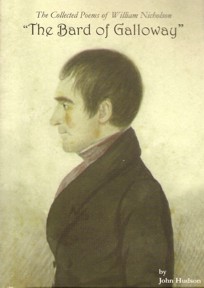
The Collected Poems of William Nicholson, The Bard of Galloway
£12.95
William Nicholson was born at Tanimaus, in the parish of Borgue, near the town of Kirkcudbright in Galloway, South West Scotland, in August 1783. He was the youngest of eight children. His father was a carrier, then a farmer and finally a publican in the town of Red Lion, today Ringford, four miles north of Kirkcudbright. His mother, we are told, loved to tell the young and apparently spoilt William stories beneath an old hawthorn tree, and in later life the poet credited his mother with inspiring his poetic gift.
By the age of 14 Nicholson adopted the trade of packman, buying a stock of wares and travelling from town to town and farm to farm and generating a steady business, no doubt enhanced by his story-telling and affable personality. However, business was not all plain sailing and fluctuations in the market, especially in the price of muslins, frequently meant his trade ran aground. According to accounts he was also in the habit of taking time out in order to play the pipes or compose, and the conflict of interest between poetry and money remained with Nicholson all his working life, as it does with so many poets.
In 1814 he managed to secure the publication of a volume of his poems and its success left him with a profit of £100. He invested it in muslin which promptly took a dive in value and the pedlar was back to square one. However, the book spread his fame and gained critical acclaim, so William Nicholson, the Bard of Galloway, was popular wherever he went. Success, however, played upon his weaknesses and drinking became a severe problem by all accounts. Soon after this he began to see demons that conversed with him on the ills of the world. They offered Nicholson answers to major problems, and armed with these and his own writings on universal redemption (and he a one-time Calvinist!), the poet travelled to London to inform the King of what needed to be done to cure the world’s ills.
After being mugged and lost on too many occasions a group of Gallovidian’s resident in London sent him back home. The Brownie of Blednoch was published in the Dumfries Magazine in 1825 and a second edition of his poems appeared in 1828. From hereon there is no clear detail concerning the poet’s life. Some sources say he took up the life of a drover for a period. His friends say that they knew little of him in the last fifteen to twenty years of his life. He died at Kildarroch, Borgue, on 16th May 1849 and he is buried in the churchyard of Kirkandrews, by the Solway Firth. An inscription on the stone set up by his brother John contains the lines, “No future age shall see his name expire”.
Category: Poetry
ISBN: 1-872350-77-1
Pages: 215
Binding: Paperback
Dimensions: A5 (5.83 x 8.27 in / 148 x 210 mm)
Published: 01/06/1999
Publisher: G.C. Book Publishers Ltd.
ISBN: 1-872350-77-1
Pages: 215
Binding: Paperback
Dimensions: A5 (5.83 x 8.27 in / 148 x 210 mm)
Published: 01/06/1999
Publisher: G.C. Book Publishers Ltd.