
Find a Scotsman in any remote part of the globe, invoke his homeland and, somewhere among the Kyles of Bute, Irn Bru, Oor Wullie and the Broons, you will meet Robert Burns or a line or two recited over and over till all the seas gang dry or at least the bar you are in dries up first.
They say the same can be said about Pushkin and Russians. Most countries have their bard who appears like a ghost in the psyche of their countrymen at moments of overwhelming melancholy, loneliness, or loss on the football pitch. Even the Ozzies have Banjo Paterson.
Cue the Irish and James Joyce. Or so we are led to believe if we follow the marketing exploits of Dublin’s Fair City. For the rest of the world, the populist expressions of simple lyricism or noble sentiment suffice; for the Irish only an avant-garde, obscure and difficult character will do.
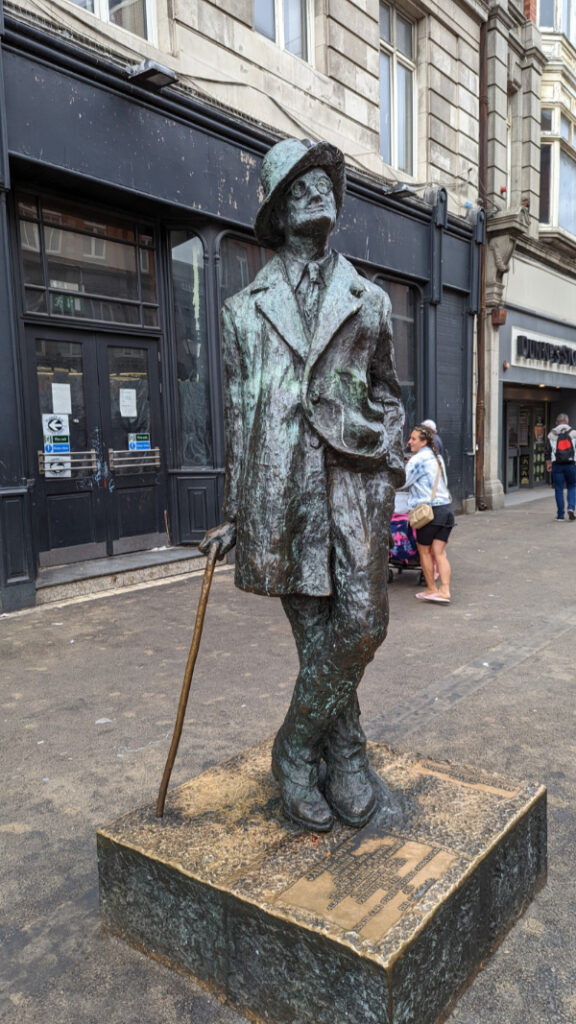
Stand Opposite the Central Post Office in O’Connell Street and who do you meet, cast in bronze? Yeats? No. Wilde – for sure he’s seated outside Kennedy’s Bar and nowhere near the birthplace of a nation. Johnathan Swift, author of still the most popular book to be written by an Irishman? Are you serious? Bram Stoker? I bet more folk have read Dracula than Finnegan’s Wake, but no. It’s the man himself. Tall, lanky Jim Joyce, whose most famous line is “Stately, plump Buck Mulligan came from the stairhead, bearing a bowl of lather on which a mirror and a razor lay crossed.” How many of you got beyond that line on page one of Ulysses?
Enter the Irish Writer’s Museum (and I will have nothing said against this incredible shrine where I was told by a museum assistant that poetry is the “highest calling” after I told him I write poetry) and you meet Mr Joyce quite a lot. You meet others. The four literary Nobel Laureates. Brendan Behan has some fridge magnets with witty phrases to make you laugh as you head for the milk. Edna O’Brien apparently wrote some interesting things. GBS has a whiskery photograph but he seems to be falling from fashion, so much so that I wonder how many people actually know what GBS stands for. Samuel Beckett didn’t say much very often but his silences are apocalyptic. And I was told that Patrick Kavanagh was, in fact, not a very nice person. There’s a whole wall full of them in room 2, with apposite quotes opposite intimate headshots. But after the prelude comes the fugue and it is a big, long fugue with lots of Joycean counterpoint.
I defy anyone but the Irish to produce a film made up entirely of a stream of consciousness dialogue consisting of made up words between two teenagers in a Dublin backstreet and claim this is of the people. It’s like my Cockney forebears down The Rising Sun pub holding bar chat in Klingon rhyming slang and claiming everybody banters in this manner all the time. But, such a film you will find in this museum. Forget “My love is like a red red rose…” No heart on the sleeve, please. This is the avant-garde posing as populist culture and it is brazen.
Has anyone noted that Joyce is difficult? He was a friend of Ezra Pound. That says a lot. The guy didn’t even like Dublin that much and got away from it as soon as he could and hardly made regular pilgrimages back. O, and he had nothing to do with the Easter uprising, despite the location of his aloof bronze staring god-like through the clanging trams to the columns of the PO. In fact, the guy did a good job of avoiding Europe at war in general… although I don’t blame him for that.
As I tried to photograph his effigy (not looking too dissimilar to the many images of Fernando Pessoa around the streets of Lisbon) a somewhat drunk and aggressive Irishman accosted me, criticising loudly the “idiots that cross in front of trams as if they haven’t seen them”. Noting that I was taking a photograph of the lofty bronze geezer, he said, “He was a great man, they shot him, the English, put him up against a wall, bang.” I said nothing.
So, Dublin’s greatest son, or one of many of them, is here enshrined on the streets, in museums and pubs, until we get to the top floor of the Irish Writer’s Museum and the First Edition. Not the Bible. Not Gulliver’s Travels but Ulysses. In a glass case, a light shining down upon it from on high, like the Book of Kells highlighted by the head honcho himself.
A few bricks start to build the temple of my understanding. They are random but they fit together. The myth begins to get a grip and I have to be careful not kneel at the shrine.
I was told by another museum assistant that there are many good commentaries on Ulysses and that if I wanted to enjoy the marvellous book I could consult them to further my understanding. I have read Ulysses. Twice, I think. I did not consult a commentary although I am also familiar with Homer which maybe helps. But this concept of a gloss takes root in my consciousness. It reminds me of priests in the Catholic Church interpreting Latin texts for the masses each Sunday morning. The idea of needing things explained is not far from the common consciousness of a large swathe of humanity. If the Bible, why noy Ulysses?
I must admit, I have little truck or should I say I give short shrift to works of literature that require extended explanation. The satisfaction gained by the initiate into obscure texts is not enlightenment through understanding a difficult passage but superiority over the person next door who reads more direct poetry or prose (if at all) such as Burns enjoyed writing. Once this is institutionalised into a religion or a university, we are in big trouble. Know-it-alls, obscuritanists, dogmatic leaders come out of the woodwork like woodlice wearing Armani suits and no-one has the sense to call out the emperor’s new dinner jacket and matching brogues with complementary tie-pin. We are all too stupid, after all.
This brings me onto Wagner or, more precisely Wotan, the next brick in my temple. Pictures of the lofty tall Jim Joyce often involve him wearing an eye-patch. At least these are the photographs selected by curators and commentators. He had eye issues, I don’t deny it. He was terrified of going blind. I and many others along with Milton are sympathetic. But why so many photos of the author looking like Wotan from Das Ring? The god who gave the sight of one eye to gain arcane knowledge of the future (and, incidentally, failed to take any notice of his own insight until it was too late). It may be a coincidence that James Joyce looks like Hans Hotter intoning the gloomy inevitability of the twilight of the Gods at Bayreuth but, wow, it seems this guy can see beyond all things, into the very destiny of the universe. Who needs Burns when you’ve got Gotterdammerung?
Then there’s the all-important keystone of exile. Joyce, along with 10 million other Irish since 1700, got out and stayed away. For some, this would be called escape or, more nobly, emigration, but exile carries the ring of artistic authenticity. Looking at photos of early twentieth century Dublin, you can’t blame him. It looks bleak, reminding me of the rows of sooty, house-of-cards tenements that my father spent much of his life demolishing in the slum areas of the East End of London. An even better reason for Joyce’s self-imposed exile is that no one wanted to publish him. Indeed, the Irish Free State was blacklisting works of sin and locking writers and editors up. Buck Mulligan’s bowel movements and brothel visits were not wholesome enough for the new Ireland.
Instead, Joyce ran away with the beautifully named Nora Barnacle (you couldn’t make it up, unless you were James Joyce) and taught English in the crazy twilight of the Hapsburg Empire while touting his work to anyone who would take notice. I bet his students loved him and hung on his every word.
So, there we have it. James Joyce, a popular Dubliner, loved by all, good for a gab down the Long Bar, writing about the common concerns of the common folk of Dublin, in love with life, Nora Barnacle and the twentieth century avant-garde flourishing in central Europe and Russia, walking the tightrope of European politics but rightly disengaged, the Scylla of fascism on one side and the Charybdis of Communism on the other trying to pull him into literary oblivion, friend of Yeats cos he was useful and Pound cos he had connections, a fine chap, a laugh and a luminary and now, a legend.
“They put him up against a wall and shot him”, said the guy mouthing gibberish with an insane gaze by his bronze. And maybe I was that idiot who crossed in front of the tram as if I hadn’t seen it. I wouldn’t be surprised. I was obviously missing something.
Perhaps what I was missing was in that very Long Bar, where I spent my most recent evening in Dublin. The only thing the Irish enjoy more than writing a story is telling a story. As my Guinness-drinking experience proved, the Irish don’t talk while others listen, they all talk at the same time, and the taller and more incredible the story, the better. It is almost as if they are testing you to see what they can get away with. I guess it’s the art of story-telling, getting people to believe you. And the story about the lanky fella with the eye-patch who spoke in tongues no-one could fathom and who fled his homeland never again to darken Dublin’s shores and yet, would you believe it, the man became a national hero – well, it takes some blarney to pull that one off.
Oscar Wilde is still seated on the bench outside Kennedy’s. The seat next to him is empty. Would James have plonked down next to him with a Guinness in-hand? Ah, the stars and the times were not aligned. How fortunate.