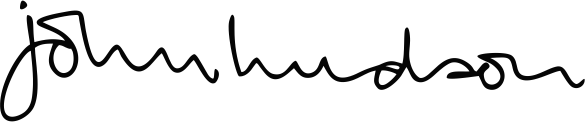
When you visit the past, either in memory or on foot, you rarely add anything to time’s scenery. How could you? Nothing has changed, the past is the past. Maybe a little subtraction as the memory fades over time or disused factories are demolished to build luxury flats and affordable housing, erasing those landscapes that only revisit you in dreams. Unless, that is, something, an event, a discovery brings something new to the picture. It cannot alter the facts but it can change your perspective.
I am walking familiar routes in Walthamstow, headed for Hollow Ponds, and inevitably I remember many things. Past loves, past pets, past family outings, snow one winter, storms one summer when lightning forked the flats around me, and my father. He would take me here as a kid. “Dad” used to spring to mind more than he does today. He died nearly 30 years ago and as time passes I get more bored by him. The dead cannot add to their story, simply repeating the same narrative with the same tired phrases in a fading recollection of the sound of their voice.
THE VILLAIN AS HERO
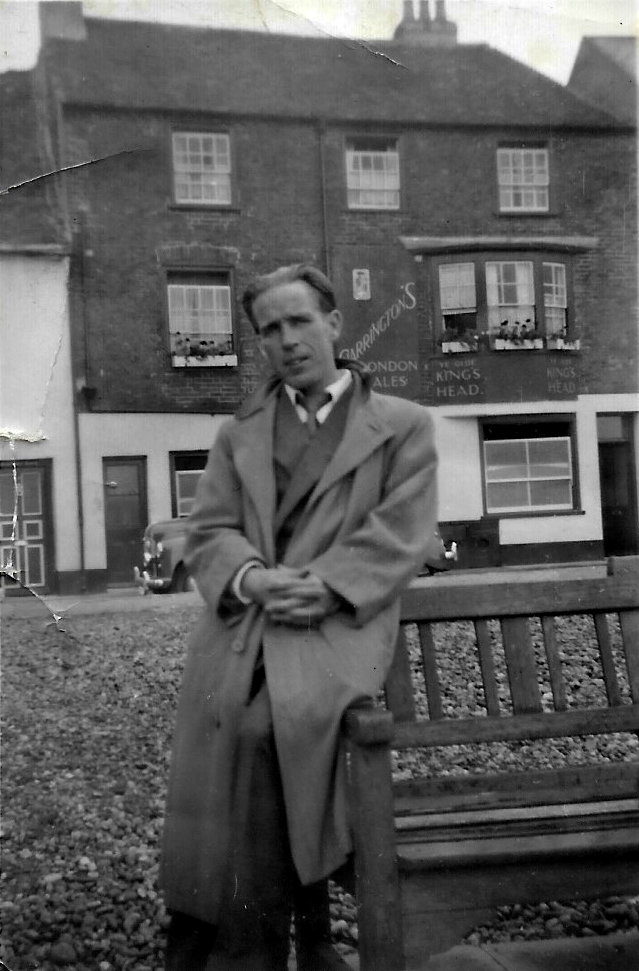
That sounds disloyal but this is a man who formed so many of my attitudes and my character and, to be honest, over the years, the hero turned into the villain. Well, my father always was a villain in the East End meaning of the word but here I mean the “villain of the piece” not the bank robber and friend and associate of even bigger villains. That’s because the East End villain was, to me, the hero. Never took orders, feared no-one, self-interested to the point of self-destructive, cleverer than everyone else, braver… the sort of gumpf you get fed by a narcissist. And when you’re young you believe it.
But as I grew up I grew to question. Much too slowly. Pennies began to drop even as the reality of the fact that he died penniless and angry was staring me in the face and I should have realised a lot earlier that the man and the myth were different things.
MIRACLES OF AFFECTION
Still, I have fond memories. The man who could display a lack of empathy for anyone did bring me Coca-Colas when I waited for him outside the pub as a kid. He’d appear at the bar door, outstretched hand holding the bottle with a straw accompanied by a “there you go son”. It was an act of love. He’d kick a ball with me for five minutes as we walked around the ponds near where I am seated writing this, before he went into the Rising Sun for an hour and I kicked my ball against the wall alone. I’d be thrown two bob when his horse won. That was love. He’d put his arm out across my chest when he had to brake hard in his van. I didn’t fly forward. He protected me.
Over time, these miracles of affection and concern paled, as I said. I see my stepsons looking after their children and they seem to do a lot more than my dad ever did. They hug and cuddle, they show an interest and instruct, they laugh and joke. I see fathers thinking about the image they are presenting to their children rather than projecting their own self-regard. My father dismissed everything, including education and job prospects, just because he never had any and thought he could rise above it. I was going to be like him because what could be better? He was who he was and he couldn’t possibly suggest that he had done anything wrong.
GHOSTS IN THE NARRATIVE
So, when a few discoveries presented recently, I had to do a double take. My father was an only son among a family of five sisters. This said a lot. It’s not an excuse for his egotism but he was surely the focus of family attention – the boy, carrying the Hudson name forward. But I never knew I had two uncles, and I don’t think he knew he had two brothers as both died in infancy, immediately before his birth in 1922. The fact Alfred and Henry never came up in conversation and my mother never mentioned it, is surely proof. If she knew something about him, good or bad, she told me.
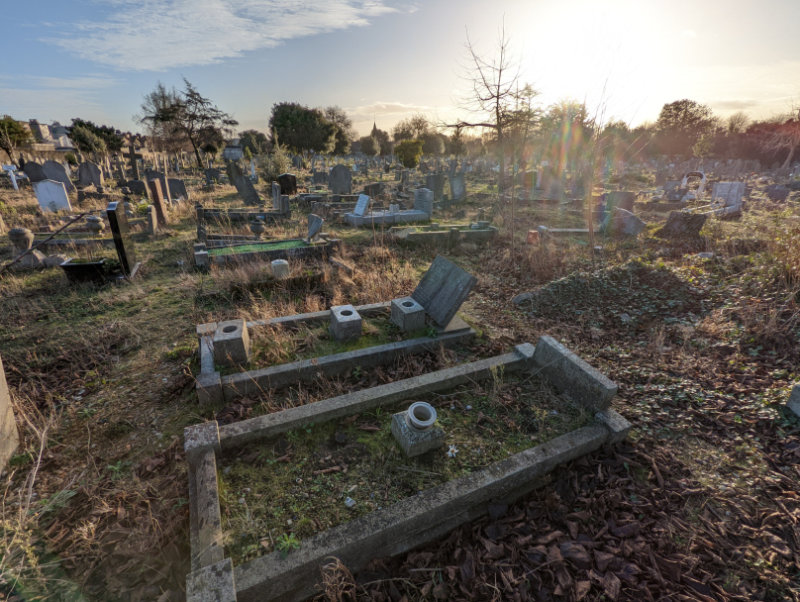
This came as a surprise. I even began to feel as if I had missed out. All my uncles were on my mother’s side and to be honest, I found them rather dull. But neither of my uncles on my father’s side got past the age of one, and they are buried in unmarked graves on the edge of Queen’s Road cemetery, not a stone’s throw from where they were born. The gender loneliness of my father is poignant. He must have been cherished and protected by his sisters who would have known of the infant deaths which goes some way to explaining why his sisters called him, affectionately, “Little Billy”, (well, he was short but so were the whole family) and why self-centredness came so naturally to him.
FATEFUL COINCIDENCE
But the real revelation came last. My father’s birthday was on the 11th October. I remember because no matter what you bought him as a birthday present, he would open it, say “nice, lovely”, put it to one side and return to the horse racing on TV or his newspaper and pint. Buying him anything induced an overwhelming sense of futility and waste. But I did it every year, partly out of convention, partly out of love and partly because had I not turned up with something, he would have commented savagely on my lack of interest several months later.
Anyway, looking at the records, I was checking out Rose Emily Hudson, nee Pollard, my grandmother who died eight years before I was born. And guess when her birthday was? The 11th October. She gave birth to my father on her birthday. Suddenly my father catapults from Superman to The Chosen One. No wonder he was untouchable, godlike and all-powerful. Can you imagine? A family, Fred, “The Bear” and Rose Emily, new to Walthamstow, have a son and he dies. Rose is pregnant again, she bears a son and he dies. Third time lucky, and on her birthday, too, William Edward comes into the world and the rest is history.
This requires a resetting of the narrative. Being the boy among his sisters and mother, his destiny was to take on the family name and the rag and bone business and probably inherit the rented yard at Willow Walk and the donkey (which, indeed, he did). Protected and doted upon, the young lad grew into a teenager used to getting his own way and with a sense of being special.
DERAILED FUTURE
Unfortunately for him, the Second World War arrived. The “front” meant death – or it did for all his mates who, coming from desperate backgrounds, living in slums and prone to petty crime, were cannon fodder. “Dad refused to fight,” was how my mother put it with a tone of moral high purpose; in other words, he went on the run.
He probably knew what was in store had he caught that fateful train to the barracks. He didn’t like taking orders, he’d always had his own way and he knew the back streets of London better than the military police that would track him for years to come. At this point, without going into detail, the only route was crime, which he took. Even after the war he was a wanted man and, inevitably, he got done twice, each time for armed robbery. By the time he got out of prison in 1953 his parents were dead and he was marrying my mum (that’s another story). He had something of a chance to go straight and he started a demolition business, for which the yard at Willow Walk proved useful (I don’t know what happened to the donkey).
REVENGE OR OPPORTUNISM?
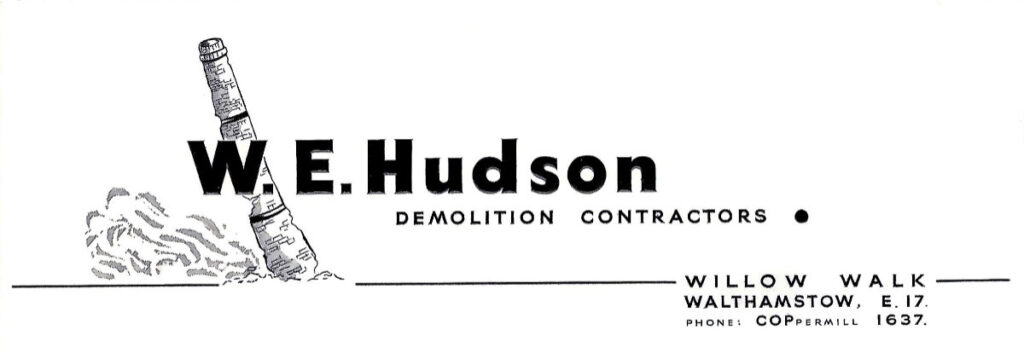
Consistent with the mythology he had built around himself, he liked to portray demolishing the East End of London as an act of revenge. He was tearing down the “dirty drums” that dominated his youth; he scaled vertiginous chimneys with a mattock in hand, dismantling brick by brick the symbols of capitalist oppression. Clearing the ground for a new, better world was the story. He was a hero.
In truth the work was plentiful, much of the profits were below the radar, it earned decent money and there was dodgy Irish labour to be had on the side. He would sing of his big jobs in the City. He cleared the ground for many of the big banks that began building high-rise in the 60s – an irony given that he was robbing them not long before. But by the time I was eight, he was bankrupt. His business failed due to his gambling and addiction to the pub and daily, afternoon naps. Basically, he was too lazy or maybe he wanted to self-destruct. The James Cagney figure, fighting against the world, cleverer than most, disadvantaged rebel, angry but with a moral core that stood for something bigger than self-interested society, has to be, sadly, abandoned. He kept the narrative going unto the grave.
MORE HUMAN
All this doesn’t alter the fact that he thought a Coca-Cola was better than a cuddle for his son, his only child. Or that horse racing was more interesting to him than family. Or the fact that the only place he enjoyed was the pub or, if at home, “kip”.
I doubt he could have put up with the demands of having more than one child not to mention the competition it would represent for a figure who had to be the centre of attention, despite the fact he blamed my mother that they didn’t have more. (My mother blamed a dicky valve in her heart and continued to use this as a reason for my only-child status until her death, unrelated to any heart condition, at 93.)
But suddenly, dad becomes a little more human, rendered vulnerable by a sad and marvellous past that I have only just discovered.
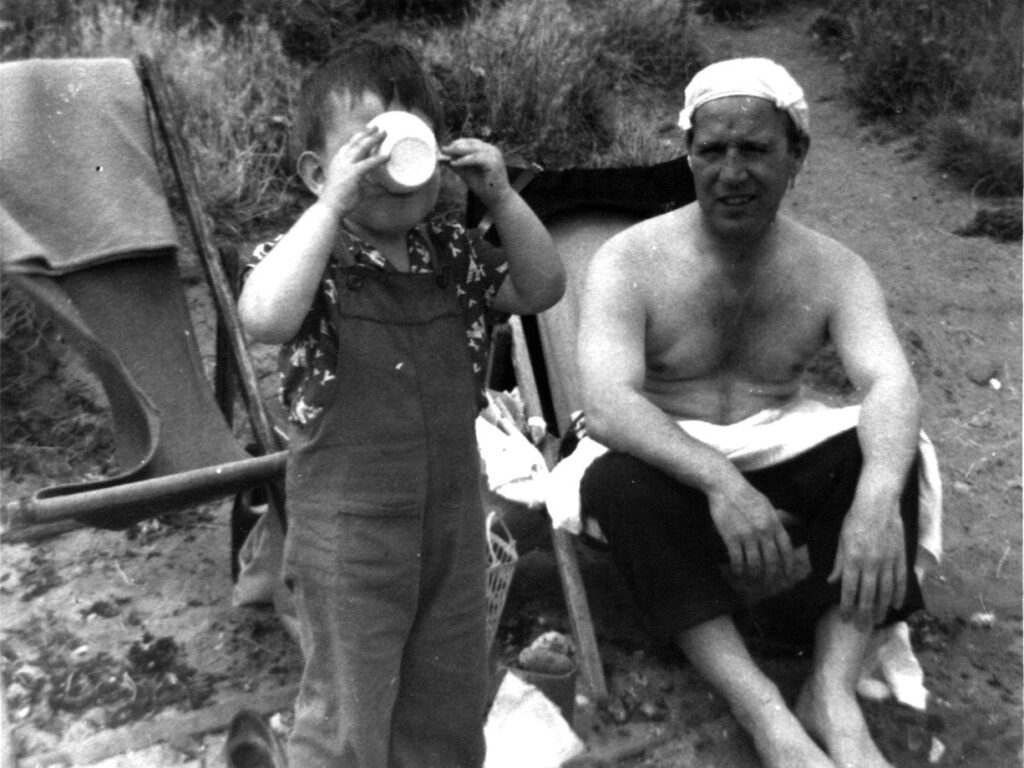
So, here I am outside the Rising Sun with a pint, not a Coke. The chatter inside sounds much the same as nearly sixty years ago. I am not sure the music has changed that much – retro seems in. I can just about imagine his face appearing from behind the bar door. I didn’t really want yet another Coca-Cola, Dad. I wanted to be with you. Part of me is still waiting for him to appear, my hero. When you revisit the past, in memory or on foot, it does sometimes change.