
I am sitting in a twelfth century church in a small French town in southwest France, sweetly named Fontaines d’Ozillac. It is one of hundreds such churches in this area, kilometres apart, each unique, although this one, dedicated to Saint Martin, is grander than many.
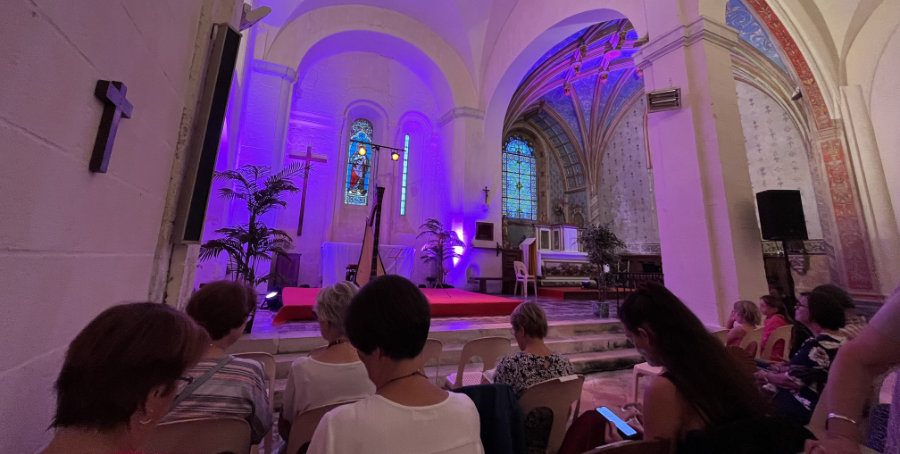
These “eglises romains” are treasures of Europe. The north of France has its flamboyant gothic cathedrals, defying gravity and credulity; the area south of Poitiers and north of Bordeaux has a constellation of humble, parish churches that have served communities for a thousand years. Thanks to a kind climate and a republic that is today generous and caring of its “patrimoine”, they are mostly well-preserved. These churches have seen the Hundred Years’ War and the Wars of Religion, not forgetting a revolution and Nazi occupation. Today, I can happily say, they are doing well, things are looking good for these modest masterpieces.
So, here I am sitting in the nave at 9 p.m., looking towards a makeshift stage and a harp and two music stands. It has to be said that it is not hordes of the Catholic faithful that keep these edifices alive today; it is a strange, peculiarly French mixture of respect for its culture and the need for what we Anglo-Saxons call “economic regeneration”.
Once upon a time, organised religion provided consolation, community, identity and a workable economic model based around the land and respect for authority; today “culture” plays a similar role with only the money input changed from working the land to tourism and leisure pursuits. But importantly for culture vultures, consolation, community and identity remain as long as, of course, they respect authority. Without authority there is no canon of greatness and majesty.
So, paying hommage to the culture that pays my wage and lends me majesty among lesser vultures, I am about to hear a concert of pieces for harp and flute. Not the most common combo. But this is France.
You’d expect 10 or 15 in the audience on a good night in a rural location in the UK, probably relatives and friends of the performers. I have heard events’ organisers claim unheard of success in Scotland on such occasions if the audience reaches 30 but 5 or 6 would probably constitute a public event and get a mention in the local rag, commanding headlines such as “Something for Everyone at Gala Do”.
The French public like to arrive fashionably “juste” at concerts, so just minutes before the mayor is about to make her obligatory and often long speech, I raise my phone as if to take a pic of the stage and change to the front facing camera. I am checking the turnout. This cannot be. I arrived early in case I got lost on an inevitable “déviation” that local governments impose in order to upgrade the sewage systems in every town in the region. I entered the church and got a good seat near the front. I could hear voices behind me, murmuring, as if in anticipation. There are at least fifteen rows of pews in two sections divided by a walkway. There is not an empty place. In disbelief I stand up and turn around. Not an empty place. And a second nave which was added, I read, in the sixteenth century for pilgrims en route to Santiago del Compostela, is also pretty full. In short, if there are three hundred in the audience, I would not be surprised. The mayor is on the move. I sit politely.
There are only 500 inhabitants in the whole of Fontaines d’Ozillac and that includes surrounding farms and a community of Brits sipping pinot by their pools or back in the UK cursing Brexit and the new visa regulations but with no interest in flutes and harps.
Analysts might start to think about how they have marketed this event which is an hour’s drive from any biggish city. I can tell you, the website is not that great. Social media presence is…, well, I am not aware of it, posters are few and far between. If the flautist was James Galway… but it isn’t; if the programme was populist… no way. I must add that I heard about it from a colleague in passing.
Two elegant and beautifully presented musicians come onstage. There is no printed list of works to be performed. They speak to the audience. All the music is French… Faure, Ravel’s teacher (I can’t remember the name but a great teacher at the Paris Conservatoire, we are told, and the teacher of the teacher who taught the harpist), Ibert – I think he was French, but he won the prestigious Prix de Rome at the Paris Conservatoire, (more live programme notes), and of course, Debussy (no flautist can resist Syrinx but few can play it as well as I heard it that night). The programme closed with a four-movement sonata composed by a 19th century Breton sailor who not only composed but also painted and wrote poetry and was influenced by African dance rhythms because he sailed to African ports in his tall ship. The whole evening was expert, precise and possibly the most French I have ever experienced. And it was wonderful. The audience were on their feet applauding and they got an encore. More Faure. The concert finished at 10.35 p.m..
It doesn’t always work out like that. There are flops. It is inevitable but this is not the first miracle in a church that I have witnessed and I doubt it will be the last.
As the public filed out slowly, chatting energetically and heading for a glass or two under the stars in the town square which had been laid on by the organisers (could this be why so many turned up?), I remember an evening where I was meant to be performing at some family fun soirée organised by the Town Hall thirty miles north of this church. As part of the evening there was a quiz… for 5 to 10 years’ olds. Well, it was less part of the evening as, hosted by an over-zealous culture vulture, it became the whole evening. The questions were about poetry and I was meant to “participate” by way of reading the odd poem. I began to worry when the quiz master posed a question to a team of seven years’ old. It was on the work of Fernando Pessoa and then he followed up with another on Rilke’s Duino Elegies. I don’t know if the children were flummoxed but I was. On that occasion I left at 10.30 p.m. when all the children had fallen asleep in their mothers’ arms. I hadn’t read a single poem. I guess belief in culture works in many ways. In the UK, children go to theme parks with expensive and obesity-inducing treats lined up; in France they get Pessoa and Rilke. That was thirteen years ago. I wonder if some of those kids were in the audience tonight?
Many will debate the worth of such cultural genuflecting although many who question the French devotion to culture perhaps don’t really like culture at all. But on this evening in a remote part of Haut-Saintonge, the culture dividend paid-off big time. How do I know? Because we all left with smiles on our faces in a genuine mood of community and friendship.