I always enjoy visiting Frankfurt but I don’t understand why.
A few years ago, on a walk not dissimilar to the route I plan today, I remember stumbling into the medieval town square after trudging kilometres of grey high-rise blocks and shopping malls. I suffering a time-traveller’s punch in the gut. Traditional Hesse buildings, clothed in the architectural equivalent of lederhosen, encircled a civic space where a gay rights rally was taking place with pink balloons and trumpets. My disorientation was soon dispelled by a public notice that explained this space-time anomaly was entirely reconstructed in the 60s and that, rest assured, normal service with its grey concrete and brash materialism was strictly resumed behind the fairy-tale facades.
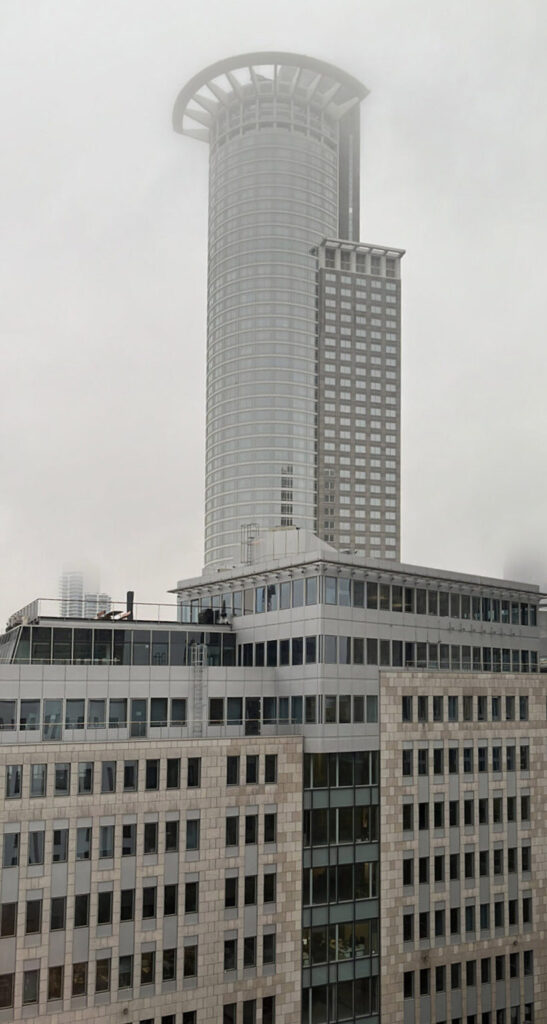
The Frankfurt I have come to know is a city shaded grey. It went through a town planning nightmare of stops, starts and funding shortfalls after the war and its attempts to cure that legacy and secure its place as a world financial capital have continued in the grey vein.
I am in a rooftop café in a department store on the Zeil, not too far from that tardis town square, looking back across the high rises I have just negotiated. They are all grey. Dark grey, mid grey, light grey, nearly white but not quite. The sky is also grey despite the occasional threat of sunshine. Indeed, Frankfurt is one of the few places I know where the appearance of the sun can make the sky greyer. Conversely, I have known foggy days here that seem quite bright. It is as if the city is afraid to wear colour.
BETWEEN BOOK ENDS
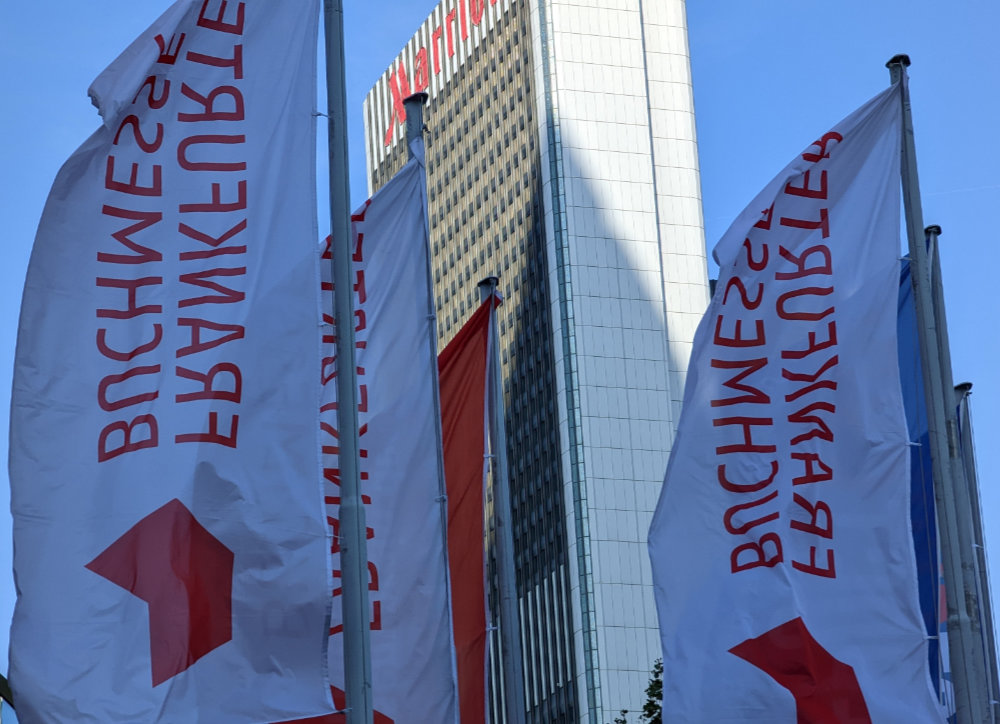
Of course, I am here because the Book Fair is here. The very fact that the world’s most important book fair takes place in Frankfurt and has done for hundreds of years gives Frankfurt a prominent place in world history.
The great book collections of the Western World often started life here. In the centuries before courier deliveries, widespread retail and Amazon, if you wanted a book or books you had to come to a book fair or employ an agent to come to a book fair on your princely behalf.
But the Frankfurt Book Fair is not the reason I enjoy Frankfurt. So, what is it about this grey city?
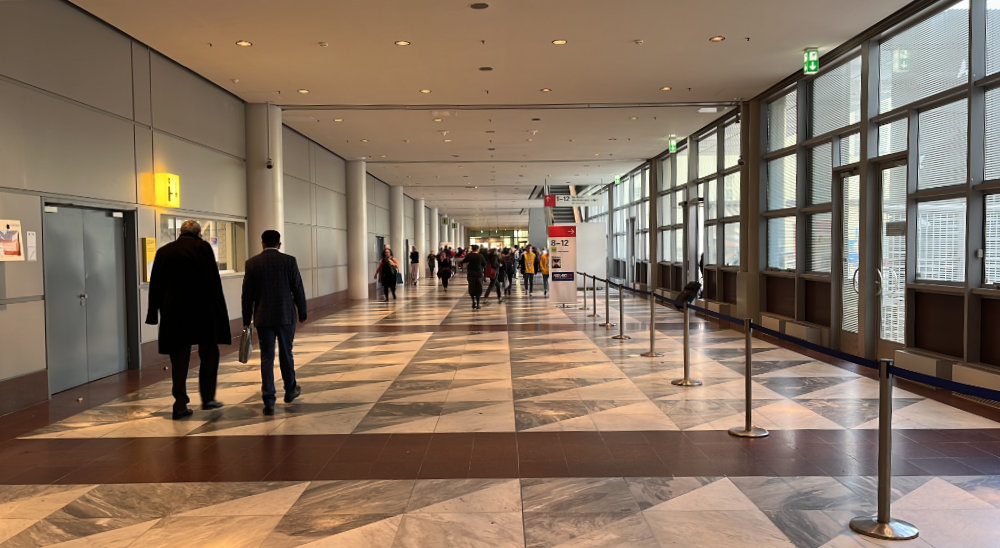
That is why I decide it is time for a walk. The “Messe” where the Book Fair takes place is a warren complex of buildings and best left as quickly as possible. It probably goes without saying that it is largely grey. However, what lies ahead is hardly technicolour. There’s the odd building on brief stretches of the Mainzer Landstrasse that reaches back into the 19th century. Pockets of bourgeois architecture that wouldn’t merit a nod and a wink if they weren’t so rare, all the more noticeable because they are red squirrel brown and milky coffee cream. There’s a very big anonymous 60s block, daubed with alternative posters, political graffiti and adopted by the homeless, that hasn’t been in use for years. These are common around the city but this empty lump of masonry and reinforced concrete is the biggest and most central.
EVERYTHING BEGINS AT THE BAHNHOFF
However, in general, buildings on this thoroughfare climb up and up and up and are very corporate. There is a very pleasant area to the north and east of the Messe that I am sure is nice to inhabit. There are a lot of embassies, trees and expensive cars and restaurants that require a mortgage if you want more than one course and a bottle of wine. I am not going there today. I will need lunch for under 50 euros. No, I am going to make for my next goal, the Hauptbahnhoff.
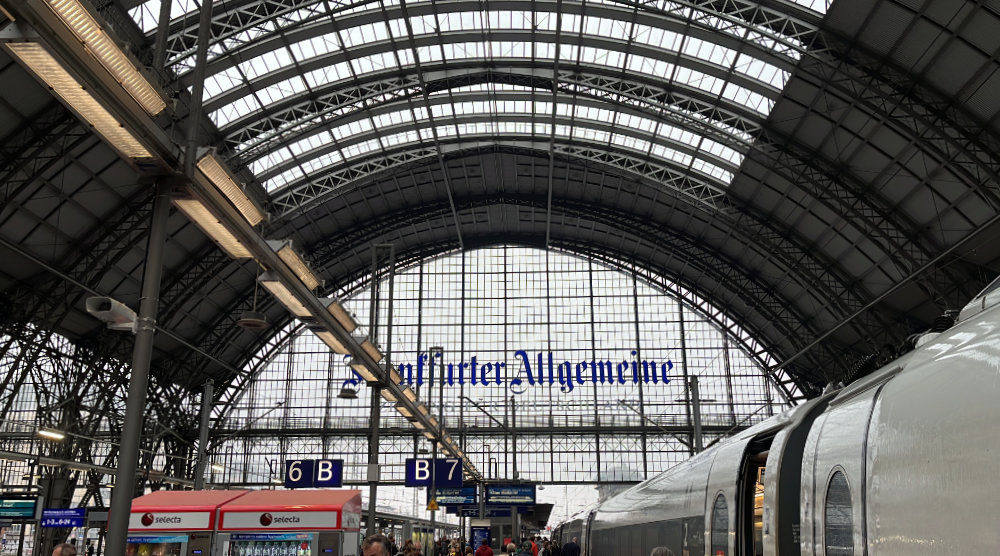
This is some building. Grand. The iron arches striding the concourse seem to stretch forever into the distance and each platform is long enough to provide a work-out for an Olympic athlete. You have to admire German train stations, they display such purpose and faith in the future, they enjoy being big and bold and strangely comforting, as if to say your train will arrive on time and get you to your destination safely. Frankfurt is one of the best. And, I have to add, people are not tripping over each other, the parterre is clean, the lighting muted (one might say grey) and the announcements clear, not screeching. They are also in English, with a better English than you will hear, if you are lucky to hear anything at all, in a UK station.
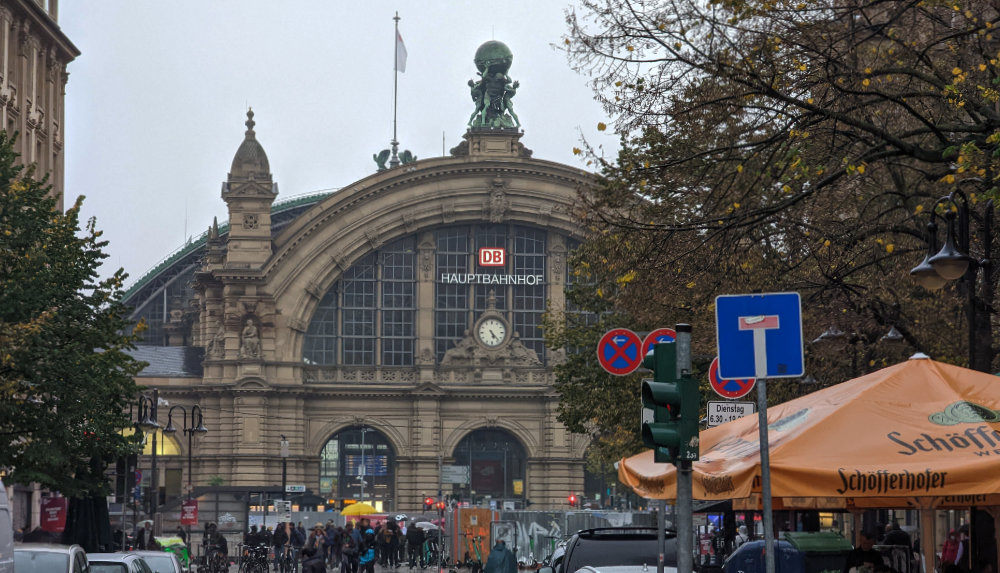
I have heard dodgy stories about Frankfurt Bahnhoff. It is dodgy. There are dodgy characters everywhere. I’ve known a friend exit the gents’ toilets with a grey pallor muttering something about vigorous sex in the next-door cubicle. You will get offered drugs of varying strengths according to your taste or addiction. It is placed in the penumbra between international business travel and the red-light district – which is where we head next.
SCORES AND WHORES
Sex is big in Frankfurt and it is also very visible as is heroin addiction which lives, needle in arm, on the streets alongside the whores and pimps.
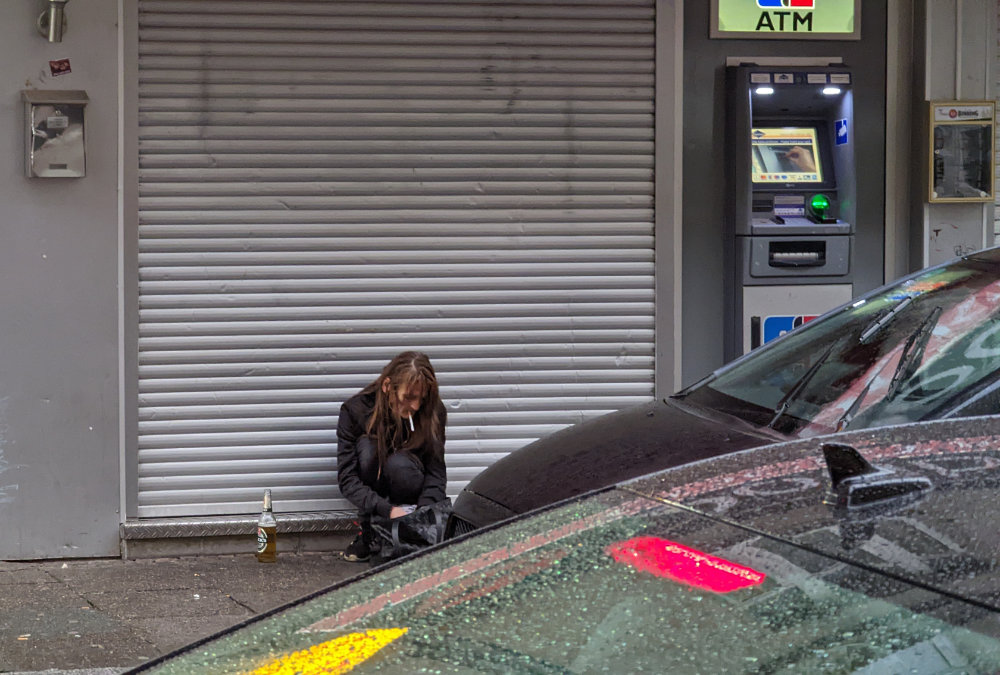
I’m walking here too early in the day to experience the joys or horrors of Frankfurt’s red-light district but I arrived the other night and braved the streets as it is the quickest route to my hotel. The area holds the kind of fascination that a corrupt priest might feel for Dante’s Hell: revulsion and a dark, obscene pull. You have to come here. This is humanity, too. Don’t visit as an indignant voyeur, rather as a lover of all that is human.
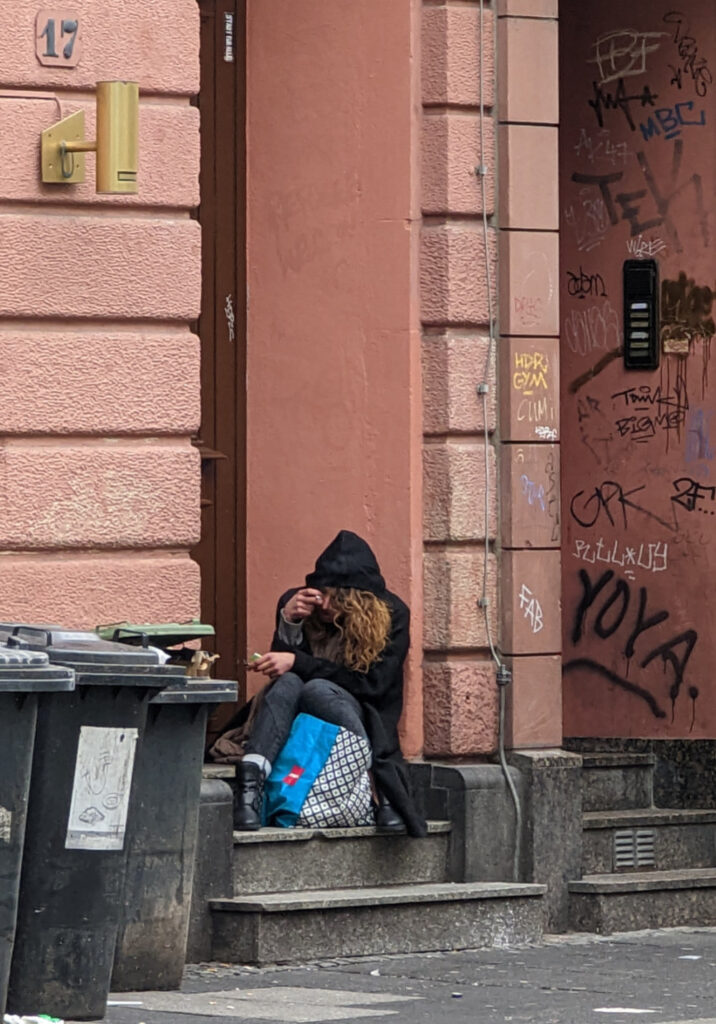
I think it has got worse (or better, according to what you are looking for) since my previous visits to Frankfurt. There’s a young woman in a doorway desperately trying to melt her next fix over a candle but fumbling and failing in frustration. Others help each other out, injecting in a kind of addicts’ merry-go-round. The sex is raw and spills onto the pavement from large buildings several stories high. The real action goes on upstairs and along corridors, rows of small rooms with diverse services on offer. The night I walked to my hotel, blokes go in like going through the turnstiles at a football ground. On the way out they have the habit of shrugging their shoulders and zipping up their jacket. I guess some kind of relief has been achieved. The “girls” go to and from work. They are not dressed for the office (unless as secretaries), but they look very business-like and in much better shape than the woman failing to fire up her fix in the doorway.
Yesterday, my path was crossed by a remarkably fit looking thirty-something wearing the tightest pair of leopard-skin trousers filled to bursting with Botox, and weighed down with an Alladin’s cave of bling. She looked totally terrifying and more purposeful than a Wall Street stockbroker heading for the floor.
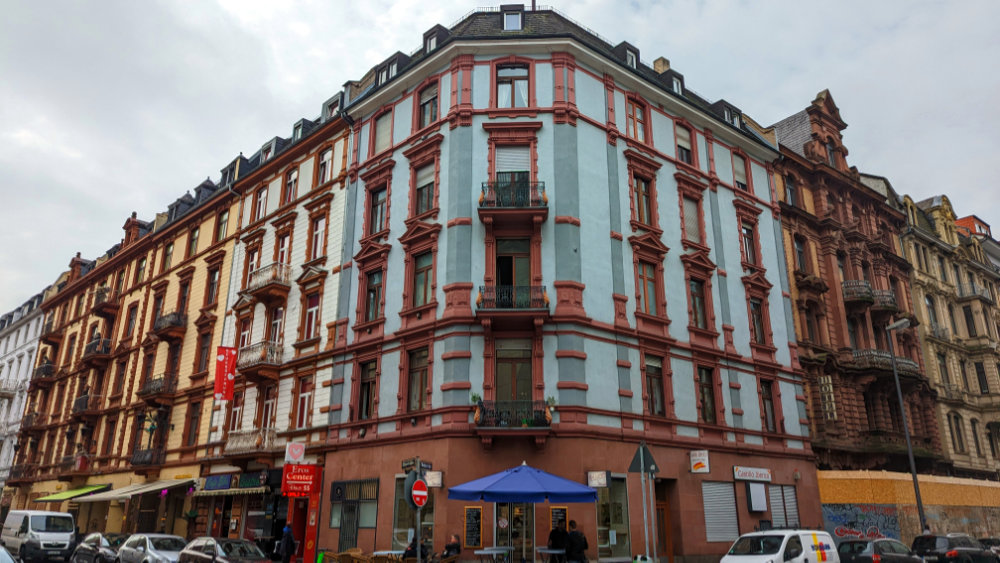
This morning, as I make my way past the bourgeois apartment blocks that offer a strong sense of heritage to this quarter and that house these brothels on a mega scale, a window opens and a buxom blonde hangs her assets as she breathes the morning air. I guess it’s twenty-four hour service. It’s amazing how some industries just keep on giving while the trains, the postmen, the doctors, the oil workers, in fact almost everybody, is on strike.
I must admit, you don’t want to stand still in the red-light district. You feel you are making yourself vulnerable – it’s probably just me and my East End of London alarm bells that ring on what I believe are dangerous streets. But keeping moving is the best strategy unless you want to avail yourself of the services on offer, when I guess you have to stand still at some point or even lie down.
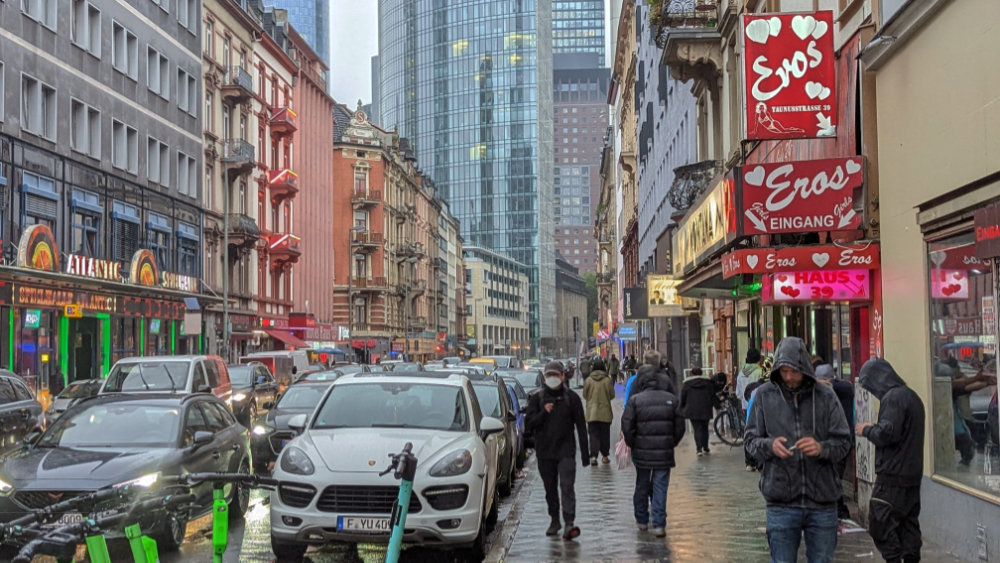
However, despite it being named red, this district is still rather grey. There are shades of brown, I guess and some flashing red lights with arrows directing you to Eros but the dodgy geezers in puffy jackets looking to sell you sex or drugs are always grey and they slip into the shadows like a fox behind trash cans.
WHERE THE MONEY IS
It is only a matter of meters before I am smack bang (perhaps a bad word choice) in the financial area. The cynic in me can’t help reflecting on the closeness of finance and moral corruption. It’s a short hop from spreadsheets to spread sheets…
Next to Willy Brandt Platz there is a giant euro sculpture. Yes, that’s the currency euro. It tells you in unsubtle terms where you are: the home of European money. Interestingly, just across the tram lines is the opera house and rising overhead on the other side is the Deutsche Bank building. We have three sides of the square that makes for life itself: sex, opera and banking. We have the fourth a few meters further down the road: shopping.
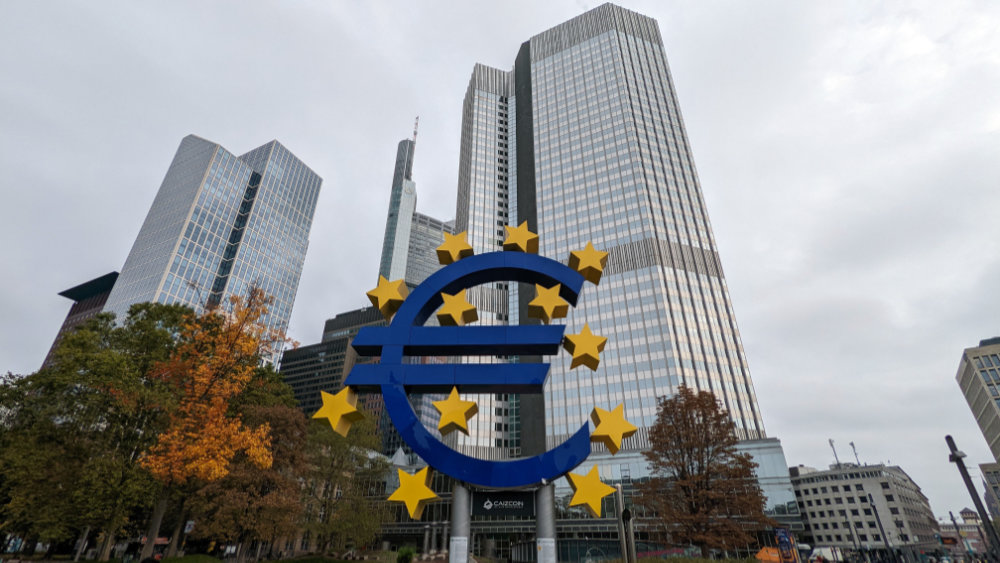
But I have to dwell on this euro sculpture for a bit. It was conceived by Ottmar Horl and it has been described as ”a work of art with too little art”. I spot a note posted on one of its giant legs. A thirteenth star has been added, it says – which is maybe why I am so uneasy in front of it. Or at least that is what I feel I should feel but then I count those stars. Is this a joke. Can bankers not count?
The explanation runs that there were originally twelve stars circling the giant 3d presentation of the euro symbol that you see on every banknote and coin. These stars represented the twelve founding countries of the currency at Maastricht in nineteen ninety whatever…. But it was decided to add a thirteenth to represent the thirteen nations that have joined the euro since two thousand and whatever. In the light of this piece of artistic prestidigitation and contrivance, I guess it is just as well the UK didn’t adopt the euro, else they would have had to take a hammer to the new star in the sky or maybe added a red cross somewhere shooting out of orbit into a grey never-never land of purposelessness.
I can’t help finding the explanation about the stars and the supergluing of a new one completely fatuous, even if it is a joke. It is symptomatic of what much modern art suffers from: actions that require tedious explanations to avoid otherwise obvious conclusions drawn from a broader cultural heritage. It results in screeds of pointless and boring text on gallery walls. The fact that the numbers 12 and 13 have significantly greater meaning in terms of religious story-telling and art, not to mention 12 as the base for time and thirteen as generally thought of as, well, unlucky, needs unexplained so we can appreciate the meaning of the thirteenth star hanging like a rogue burner in the constellation of euro heaven. Well, they spoilt it for me; its once apostolic message has turned Judas. That’s what 30 pieces of silver gets you.
GOETHE THE INFLUENCER
Anyway, time to square the equation. It’s another short hop to the shops, and Frankfurt loves its shops. I guess you have to have something to do when the skyline is so grey.
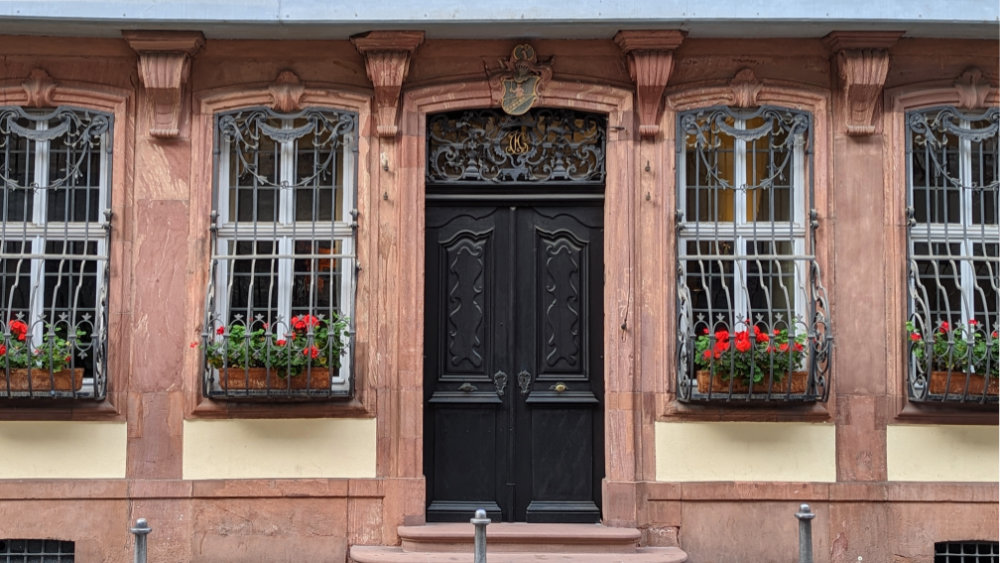
But wait. I am bypassing the Goethe Haus, and I promised myself I would visit it on this trip to Frankfurt. Goethe was born in Frankfurt. This is my chance to meet the great man. The information panels dotted around the streets and often surrounded by confused Japanese tourists, state that a visit to the Goethe Haus is a chance to see a furnished bourgeois house from the late eighteenth century. I can’t help but think the strapline is a bit of an undersell when one of humanity’s greatest spirits had his nappy changed there.
It is a well-to-do town house and Johann’s parents were well-to-do and politically engaged at high level, even attending the coronation of Emperor Joseph the second with Johann in tow. However, I feel a bit uneasy about this guy after only a few rooms.
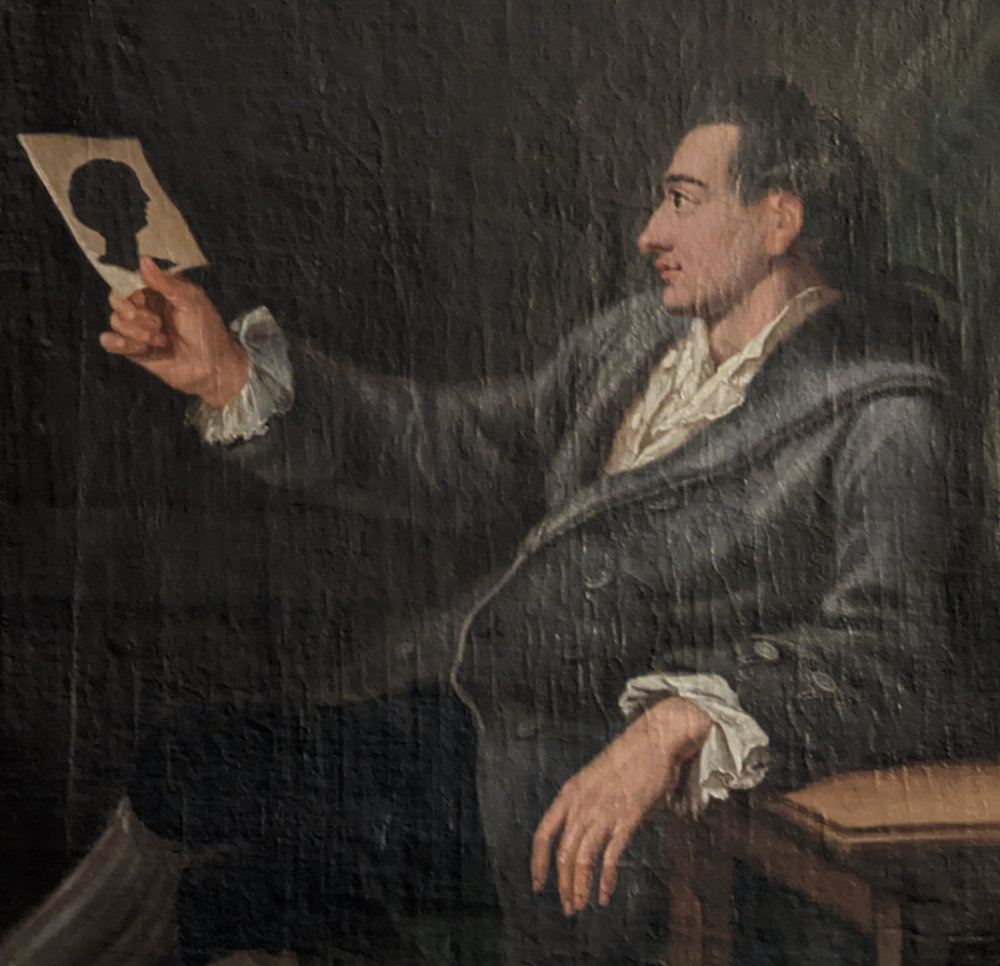
Goethe is a bit of an enigma to me. I don’t know his work well. Faust one and two, Werther via Massenet, a few famous poems, a few more Schubert lieder, the last movement of Mahler’s eighth, a passing knowledge of his work on colour, a few tales about his interactions with Beethoven… the kind of stuff you pick up from a general cultural curiosity but I appreciate he is a big name and is seen as Germany’s answer to Shakespeare, Dante, Moliere, Cervantes etc etc… but there is a bit of selfie culture about Herr Goethe. I mean, he seems to remember his birth in vivid detail and he writes at length about the liaison of the planets that picked him out as special. Apparently, his arrival was slightly delayed by the moon.
As I move from room to room – and there are three floors of them – I am getting to know what would be known today as an “influencer”, with all the self-centred, self-regard that goes with it. Come to think of it, the pitiable Werther, that influential romantic sufferer, seems a dead ringer for the Goethe I am encountering as I climb the steps towards “The Poet’s Room”.
En passant you come across baby Johann’s toy theatre which, apparently, inspired his love of the real theatre, a seed of inspiration that grew into the eminently unperformable Faust Part Two. Two young girls are inspecting it, housed in its glass cabinet. It looks like a film set shrunken by Alice’s Wonderland potion. They seem bemused. It is a couple of flat pieces of wood and a chessboard. I think we are meant to be standing in reverence.
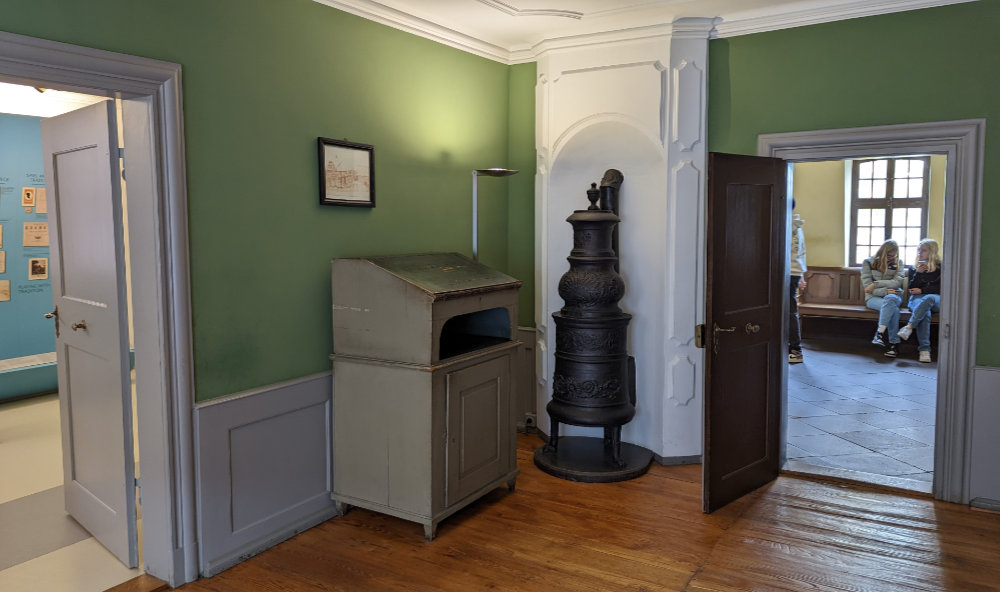
I do, it must be said, feel a sense of awe standing in front of the upright desk where, allegedly, Goethe wrote part one of Faust, many poems and bits of Werther. His drawings are hung on the walls. They are capable efforts but no more capable than many youngsters of the time with a good, bourgeois education. He trained in Law but never presented a dissertation. He got a job anyway. I guess you do when you are a genius or you have an influential father.
The visit ends in The Music Room where the happy family would while away evenings, the men on instruments and the women singing. How very bourgeois. Obviously, they didn’t have the Goethe-Schubert Erlkonig to terrify them before bedtime but I am sure the young lyricist was inspired to liven up the genre on those long winter evenings.
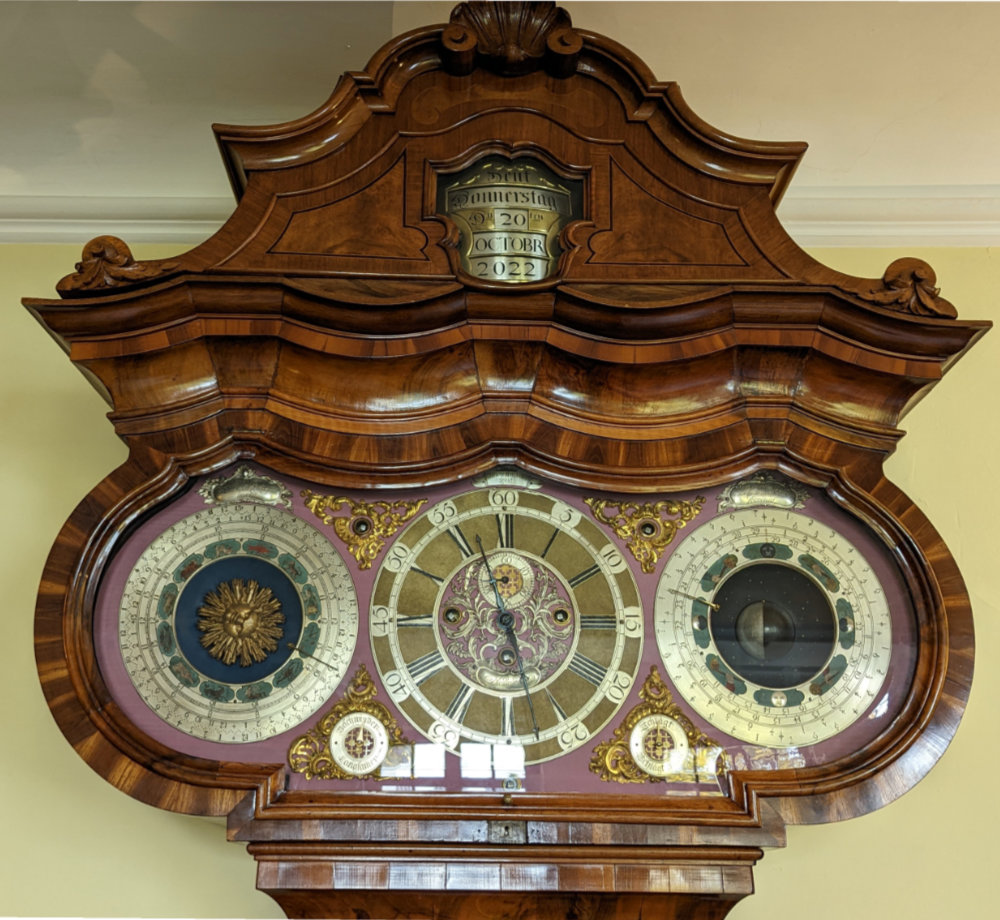
Yes, the Goethehaus is indeed a fine example of a Frankfurt town house as lived in by the high bourgeoisie of the late eighteenth century. Not a lot more. The undersell is spot on but I am glad I visited. One final note, however. It was completely destroyed during the Second World War and lovingly rebuilt so, apart from the first four stone steps of the stairs, which survived the bombs, you are not exactly treading in the footsteps of genius, only in their shadow. Time to move on. Lunch first then shopping at last.
WEIGHED IN THE BALANCE
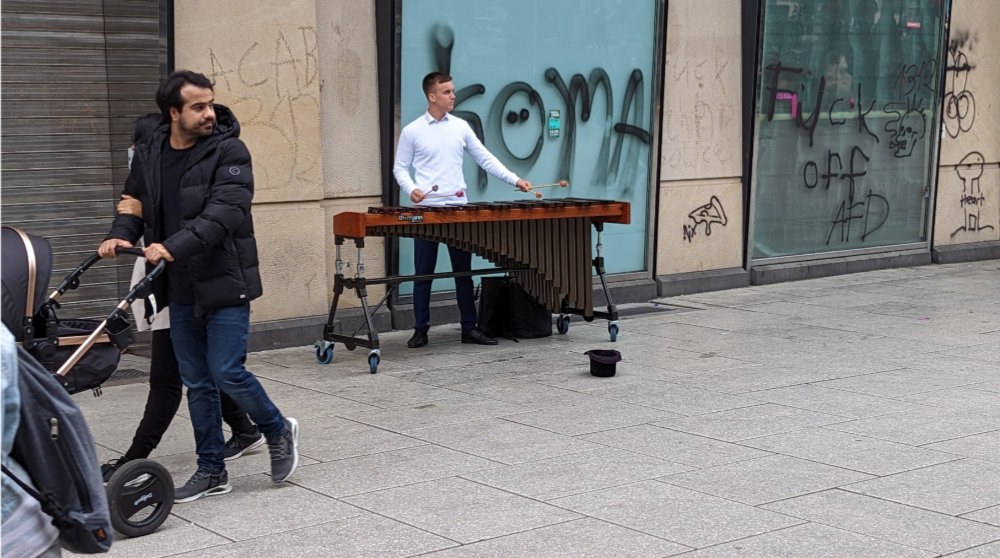
There’s a good marimba player entertaining the shoppers and he is getting coin. Marimba. What a lovely instrument to busk with even if it seems large to carry into the centre of town. Not those bloody drums and pipes you get in Glasgow, nor the thud thud thud of some would-be Eric Clapton relying on an over-amplified soundtrack to raise his heavy-handed strumming into the realm of entertainment, nor a grade two clarinettist screeching out Aker Bilk nor, the worst, that single Peruvian Indian band that plays mystic panpipes in every city in the world simultaneously. How do they do that? Time travel, I guess. Machu-Picchu magic.
Retail in Frankfurt has a kind of magnetism. The shopping malls and shopping streets are today’s equivalent of the nineteenth century’s railway stations that connected Germany to the world with bravura and purpose. The shops are fortresses of quality or kitsch or hi-tech or lifestyle lived in affluence. Indeed, despite economic hardship, there is obviously money to spend. A people that often choose to rent rather than buy property have money to spend and if it isn’t on holidays in the sun, it is in these huge department stores or niche boutiques or up market furniture shops or in Saturn, a kind of PC World on adrenalin.
I have already taken a tour of a Kloppenburg and bought a jacket and, although one can never be sated on shopping, I am aware that I have some time left in Germany and if I wish to get out with any money left, I had best show restraint today. Instead, I will simply admire.
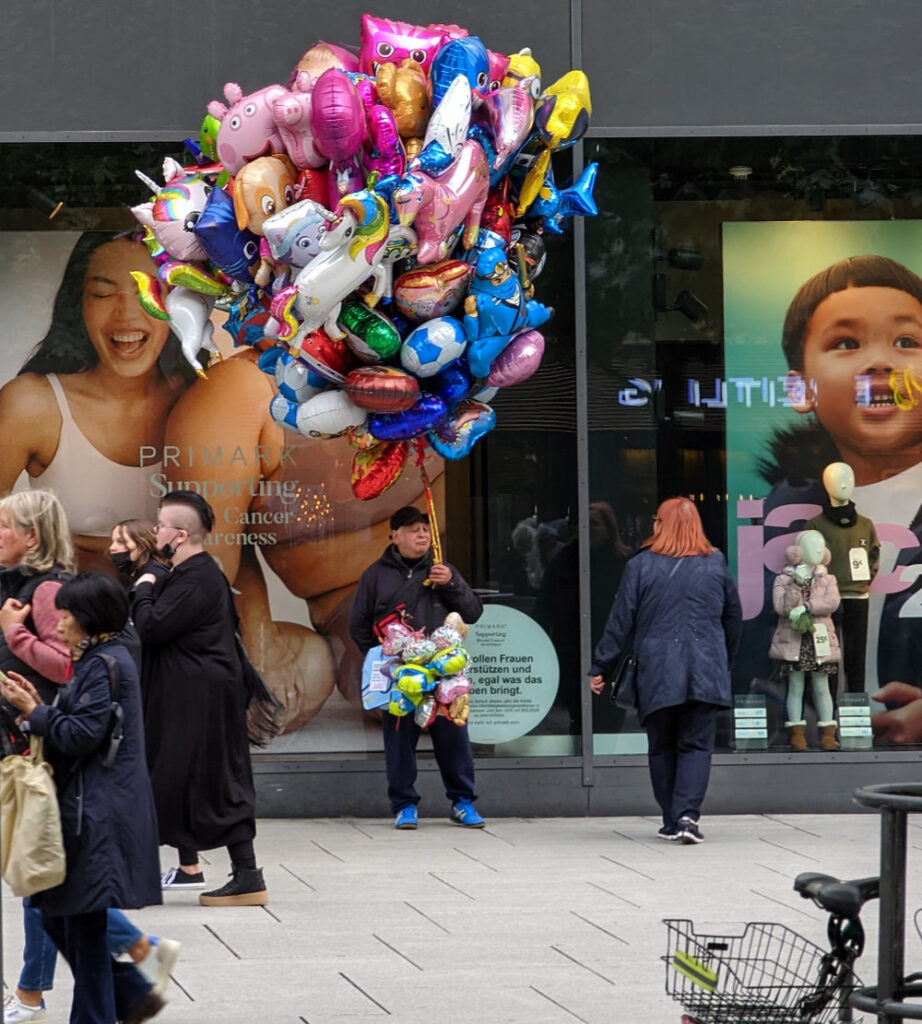
There is a mood of the fairground on the Zeil today. There should be an organ grinder and a merry-go-round and a candyfloss stall. Well, there is a candy floss stall and a man selling balloons that look like a bunch of sugary lollipops. I wonder if he has to wear lead weights around his waist. There must be enough helium in those balloons to lift him high above the city, even higher than the vertiginous Deutsche Bank building, until Frankfurt would appear a smudge of grey surrounded by fields of hops.
What a contrast to Gloucester, which I visited recently. Admittedly Gloucester is not a banking centre but that is no excuse for the run-down grimness of the city centre. I met an elderly lady in the High Street in Gloucester who told me that if Debenham’s closed down it would be the end of the shopping in this once grand market town with one of the greatest cathedrals on the planet. We all know what happened to Debenhams. The whole pedestrianised area is a parade of pawn brokers, Paddy Powers and charity shops. I went into a pub and ordered a large Tanqueray and tonic and got a single Beefeater with the commentary “that’s the last of the gin”. I sipped it watching multiple TV screens as Man U lost again and tattooed twenty something jeered and swore.
I’ll do my shopping in Germany, thank you.
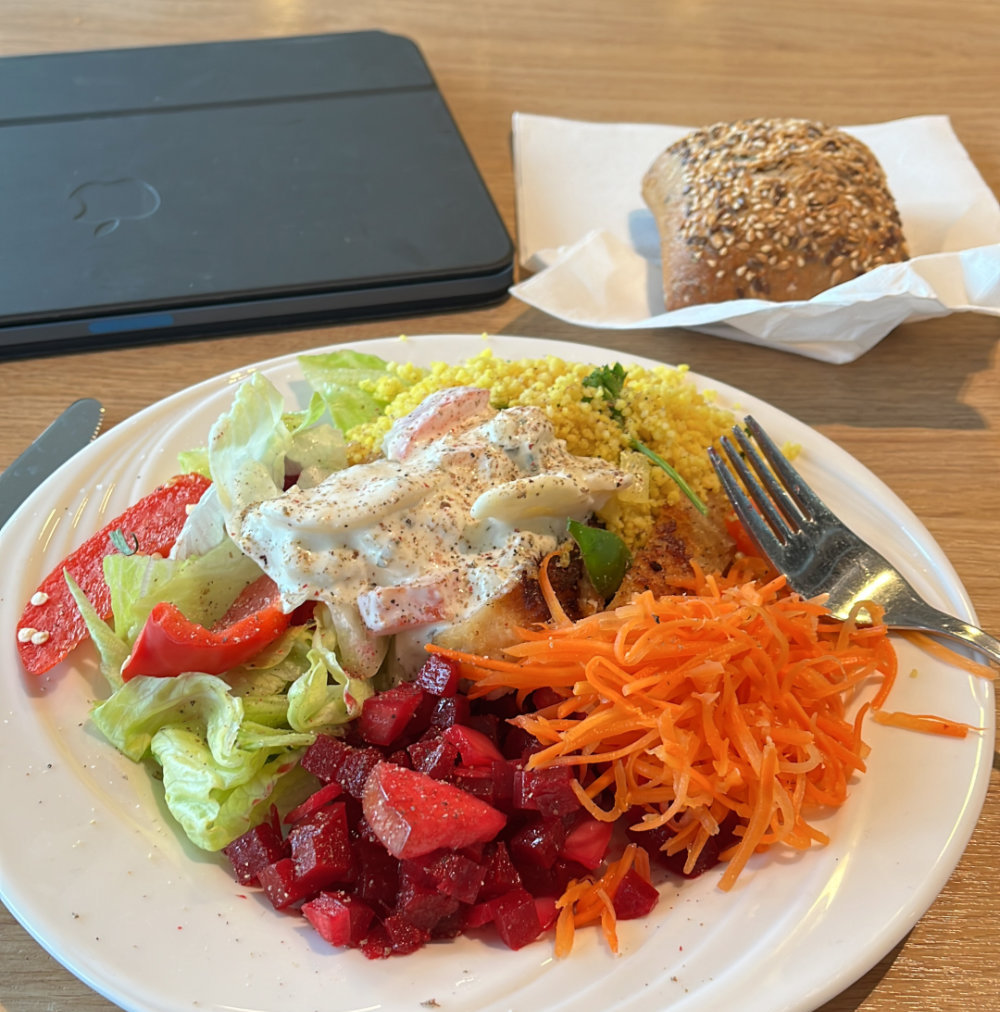
Anyway, it’s already time for lunch and I have only got halfway through my walk, the purpose of which, if you remember is to work out why I like Frankfurt.
My salad in the rooftop café in which I am currently writing was carefully weighed. Yes, weighed. Salad is sold by the gram here. It seems apposite for a banking centre, as if they are returning to the good old days when a pound of silver was worth two buckets of eels pulled from the river Main. There is a money museum just down the road, if I remember rightly. I won’t be returning there. But it is an interesting experience to be weighed for lunch and makes me think how much my gross girth would have cost me if I lived full-time in Frankfurt.
It maybe explains why the Frankfurters are slimmer than people in other German towns and cities but it’s time to move on. I could go north towards the Alte Oper but the river is calling. After all, this is Frankfurt am Main and rivers were, once upon a time, the economic highways of Europe.
OUT AND DOWN IN RETAIL HEAVEN
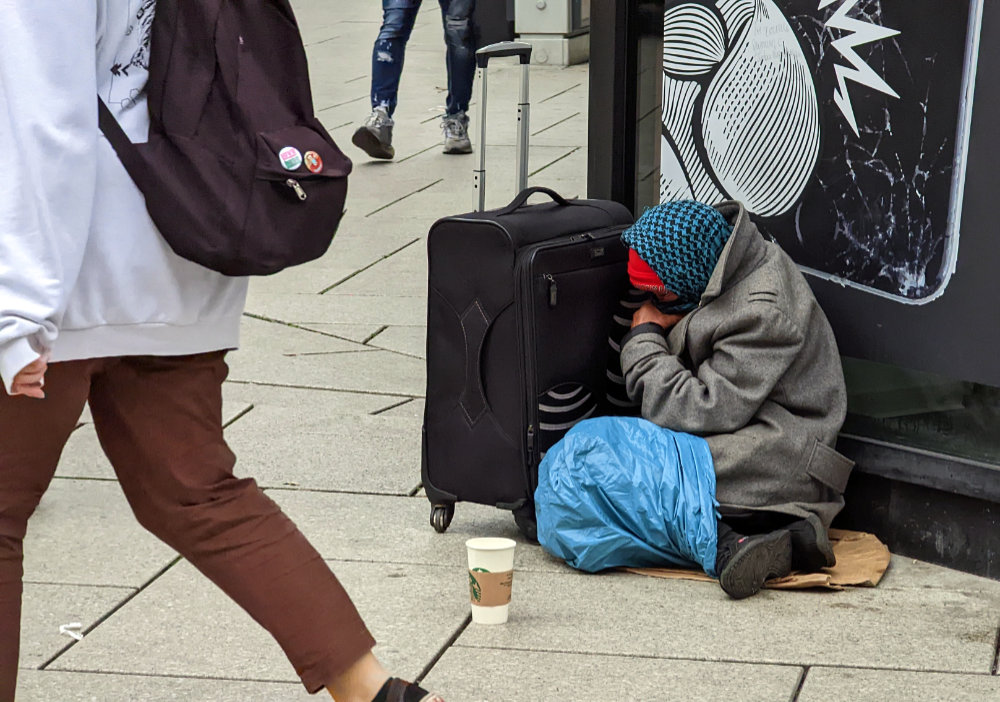
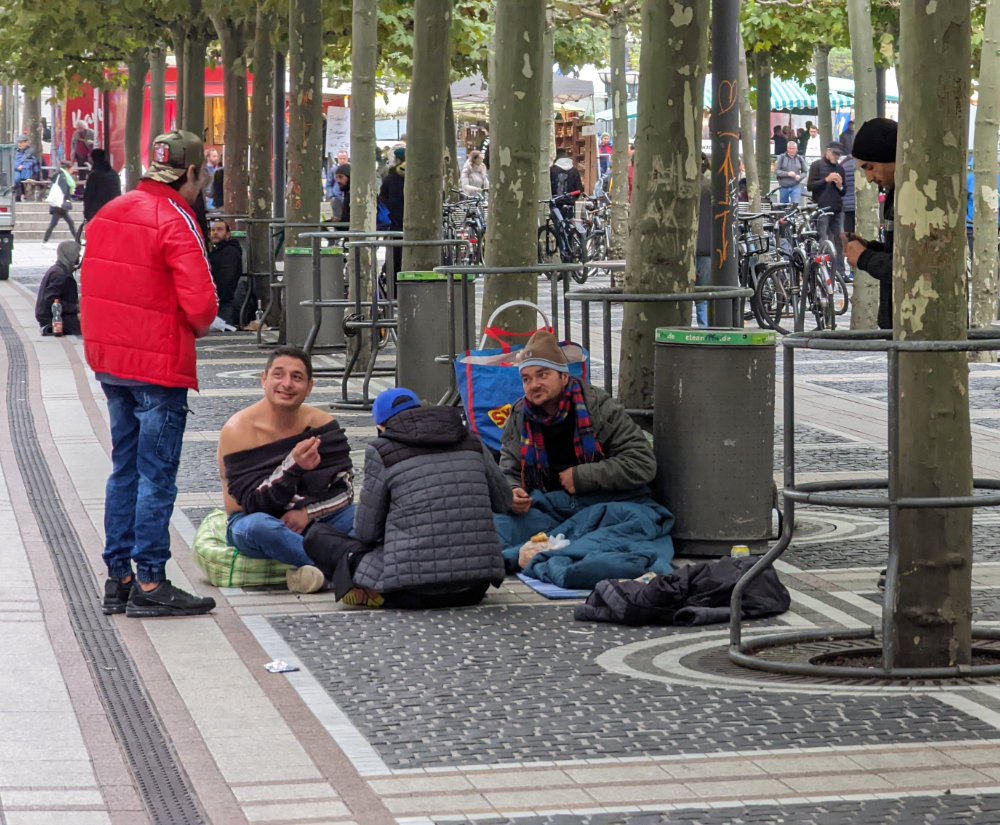
You can’t miss the homeless. They don’t sit on the benches but on the pavement. Their cardboard coffee mugs picked out of the nearby bins are open for donations. Some hold up message boards, announcing hunger or cold. Some are in groups, some are loners. The groups are chatting, mini communities within the grander swell of human commotion on the street, the loners might be dead. Passers-by step over the loners who remain motionless or huddle among shopping bags full of rags or carry-on suitcases stuffed with a life’s possessions. There is parallel world operating here. It is as grey as the wealthy one walking around it. Grey and bleak. But there is laughter here and there and dialogue between groups thrown down the street like litter. I can’t help thinking that winter is coming.
GAWD BLIMEY
It is starting to rain. In my experience, rain is always grey in Frankfurt. Never a rainbow, never blue sky with heavy showers but a blanket of smirren mixed with misery. Should I turn back. Certainly not. I can see a market up ahead and it presents a chance to ogle some wurst and sniff some sauerkraut. My persistence is rewarded by gourds. I have never seen so many gourds. I know the German’s love pumpkin soup and I have sipped many bowls of it in Germany at this time of year but what lies before me is a living encyclopaedia of gourds, a compendium of the world’s gourds, every category of gourds, a Linean gourdarama. It is remarkable. Some are tiny, others are like roundabouts, most look dense enough to cause serious damage if lobbed or fired from a canon. How or why are there so many gourds? I have no answer, so bewildered and awe-struck, I move and turn right towards the river.

It is now raining enough to soak a coat. I use the cover of buildings to shield me as do the many scooter riders who might otherwise suffer electrocution from their own batteries should they splash through a puddle (so I have read). Electrocution seems a fitting end, although mass extinction won’t reduce, only increase, the number of abandoned trip-you-up, bag-snatch mobility aids so it will not improve matters. I drop that line of thought.
I was hoping to take in a museum on the river’s other side but the gourds and Goethe have delayed me and now the rain is putting me off. The river will present wet passage. It does. Halfway across I encounter an art gallery perched on a stanchion of the bridge. Once more art comes to the rescue.
ART TO THE RESCUE
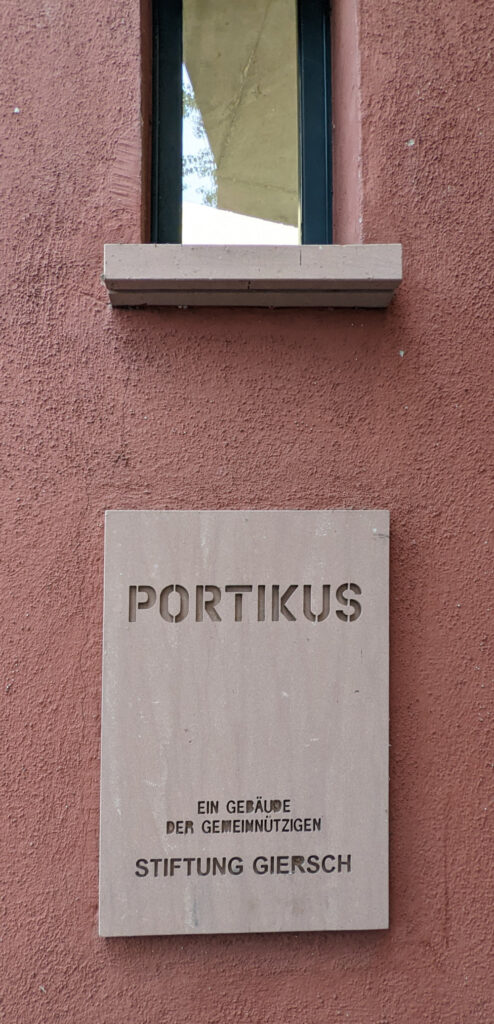
The Portikus gallery has an “everyone welcome” sign but it is still pretty empty. Two boats, I think they are called sculls, are upsides down, running the length of the gallery. They are like anorexic Viking longships. The rowlocks – I think that is the name, I know little about rowing other than it looks cold and exhausting – have been removed but books have been laid, resting on the hulls. Small rubber stickers have been carefully placed ensuring the books don’t slide off onto the concrete floor while also attaining equal height so a ridge is formed a bit like a roof. The books are in various languages. It’s difficult to make out a theme, if there is any, and as quite a few are printed in Asian calligraphic script, I give up quite quickly on getting any grasp of what this installation is about. I would say the publishers all seem “alternative” but even that is a guess that is undermined here and there.
So, after ten minutes of drying out from the rain, I am still looking at boats’ bottoms and books balancing with a few arty types standing around, chatting as if they know each other and, indeed, they may well be the artists. The most animated figure is a shaggy dog that wants out into the rain. I don’t blame him.
I am annoyed at the pointlessness of it all. Earlier I complained about obscure private narratives overwhelmed by stronger narratives in more general culture. How can you override the more obvious narrative for the obscure one? Here the narrative is only available through direct explanation. I tried.
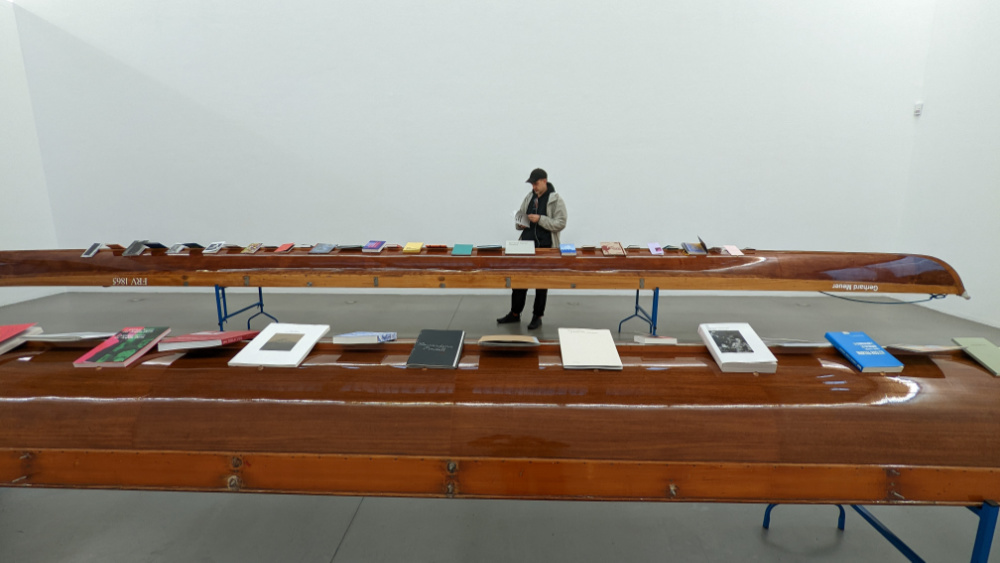
Boat bottoms. Rivers. Movement. Books on marginal topics. Movement. Linking ideas and cultures. Upside down movement. Gallery on a stanchion. The river Main flowing below. The Frankfurt Book Fair in full swing. Never mind the rowlocks, they were probably a danger to smooth movement around the hulls… health and safety issue. But the fact they are not there does suggest no power or direction. Adrift? Capsized? Culture capsized. Silly. But no one is talking to me; the artists are talking to each other or maybe the wittering ones are just in out of the rain? Who knows. Give up. Get out. Wetter is better than bored.
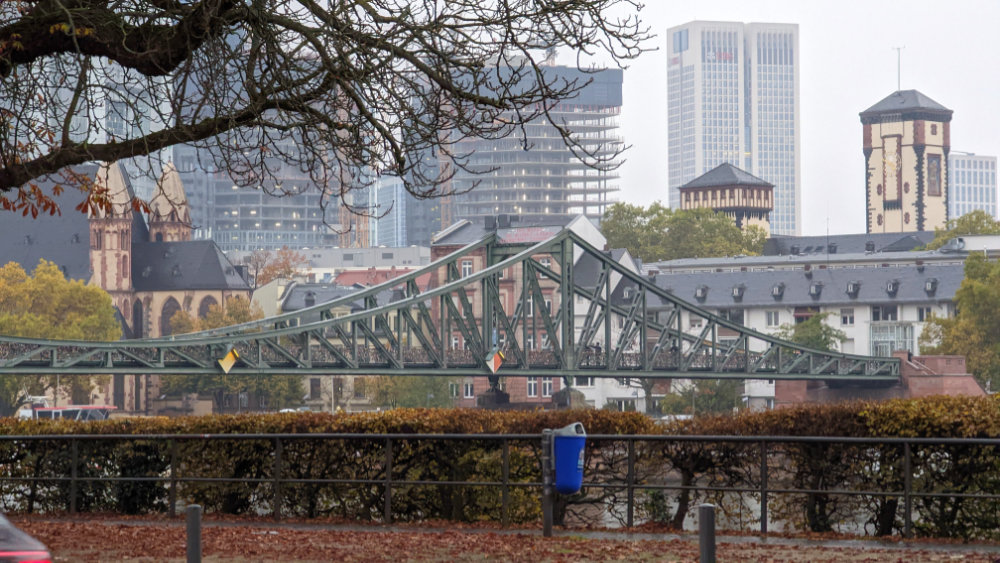
I am always annoyed that there are never enough hours in a day. The light is thickening as Macbeth might have said but I spot, on the other side of a busy road at the end of the bridge, a museum and I reckon I have enough time for a gander. It houses icons. Great. No boat bottoms. Just saints’ heads.
THE SECRET MUSEUMS OF FRANKFURT
Standing watching the red man at the traffic lights when there is not a car in sight, shows a remarkable lack of independence of thought, I feel. Standing watching the red man on a quiet road when it is bucketing rain transforms behavioural convention into stupidity. So, within a minute of leaving the Portikus gallery and its boat bottoms with not a whiff of what was going on, I now feel like a moral failure for remaining stood in heavy rain on a quiet road staring at a small image of a red man for several minutes. When red turns to green, I have lost the will to move or I may have drowned. When I move, I get claxoned by a car turning left off the bridge. That would be an ignominious way to die but due reward for my moral failure to cross when all was clear.
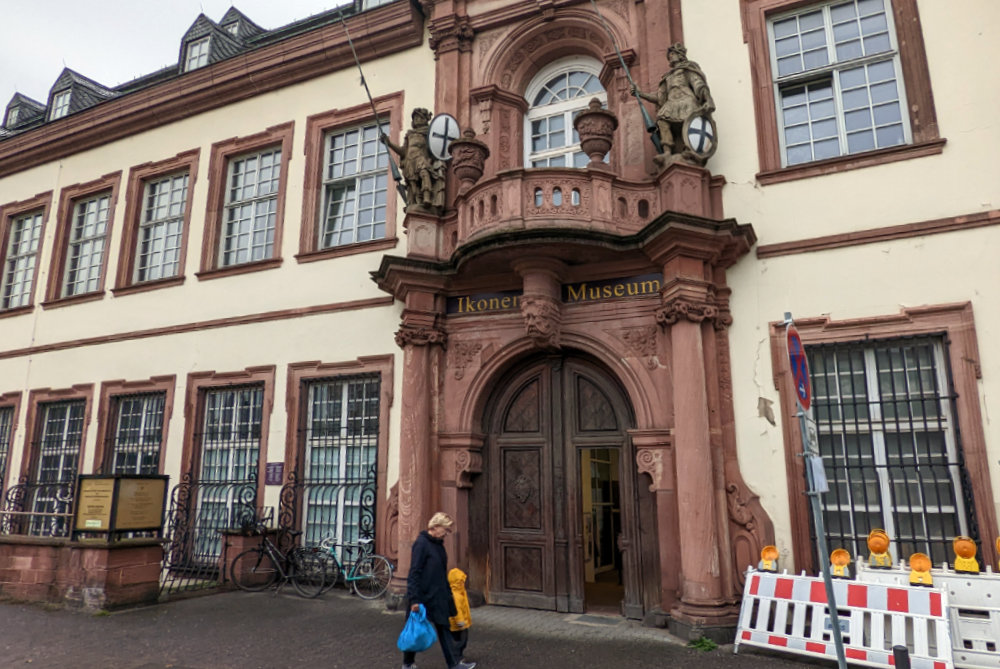
After much manoeuvring around roadworks, I find the entrance to the Museum of Icons. I have chosen the wrong day – or maybe the wrong century. It doesn’t look like the Museum of Icons has been open since around about 1875. Not to worry, there are museums all along the bank of the river. This is one of the richest museum and gallery stretches in Europe. It is just that no-one seems to know about it.
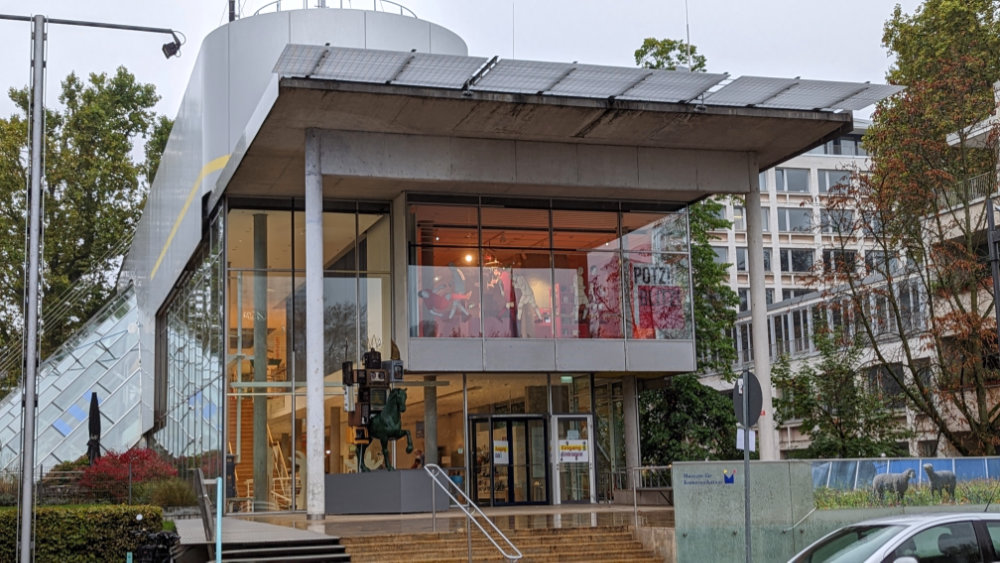
This almost universal ignorance of the wonders of Frankfurt’s cultural riches is not surprising because it doesn’t exactly shout about them. Even as you walk past them, it is difficult to know that they are there and when you do spot a big and imposing building in either imperial or modernist style, you don’t actually know what it is and it is a bit of a walk from the road to the often hidden front door to find out what it is. Sometimes the lights are off, although it is possibly open; sometimes the lights are on but push the door and nothing gives.
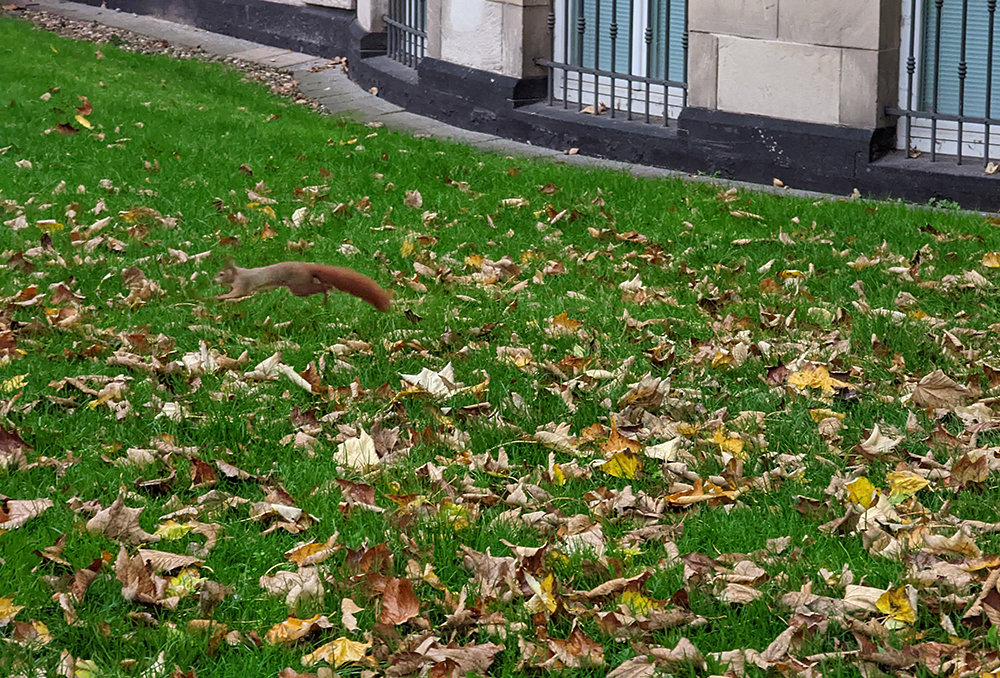
I pass a grand façade which I think houses something to do with ethnography or tribal masks and carvings and two red squirrels are sitting on the lawn and looking at me. Alert little critters, they seem quite cheeky. Their redness contrasts with the grey weather and the patch of grass. Conditioned by my red man experience, I stop in my tracks. The squirrels eventually get bored and bounce off. That was a treat. You don’t often come face to face with red squirrels. Maybe they are common in Frankfurt but I don’t care.
My aim now is the Stadl, the wonderful art gallery that has the famous image of Goethe with two left feet. This is a hopeless quest as I am sure it is too late to gain entry. Even if it is still open I will be politely and firmly told there is no point in attempting ingress as there is simply not enough time to devote to art before lights out.
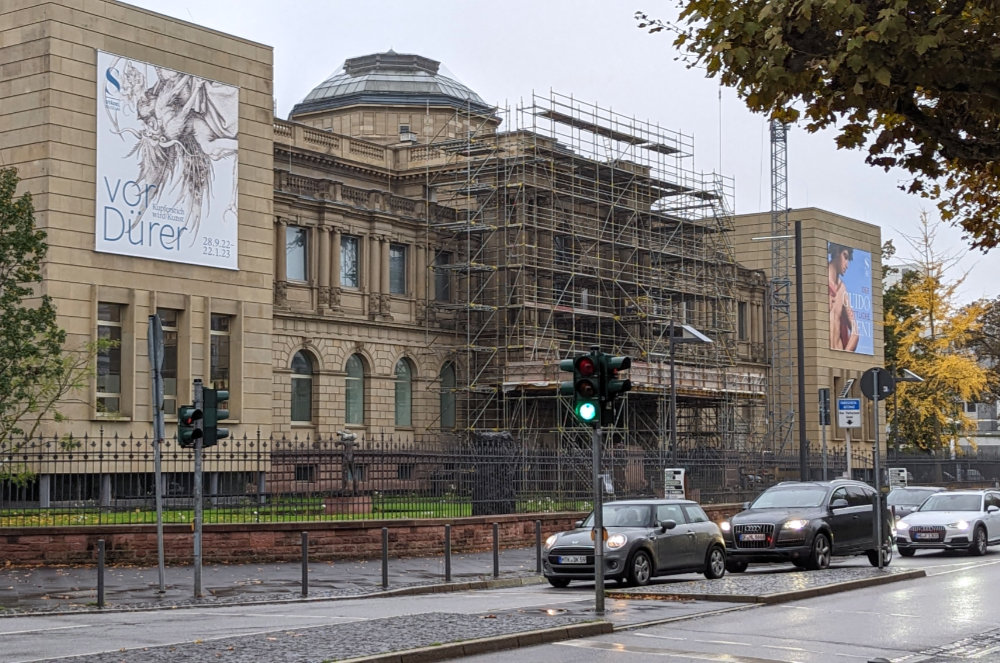
As I approach in the ever-thickening gloom, the front of the Stadl is clad in scaffolding and boards. It looks very dreary and drippy in the rain. But the grand steps have a glimmer of artificial light illuminating them so I cross the road far from any public crossing and make for the front door. You never know, I may yet again catch a glimpse of Goethe’s two sinister slippers as he lounges in Olympian splendour.
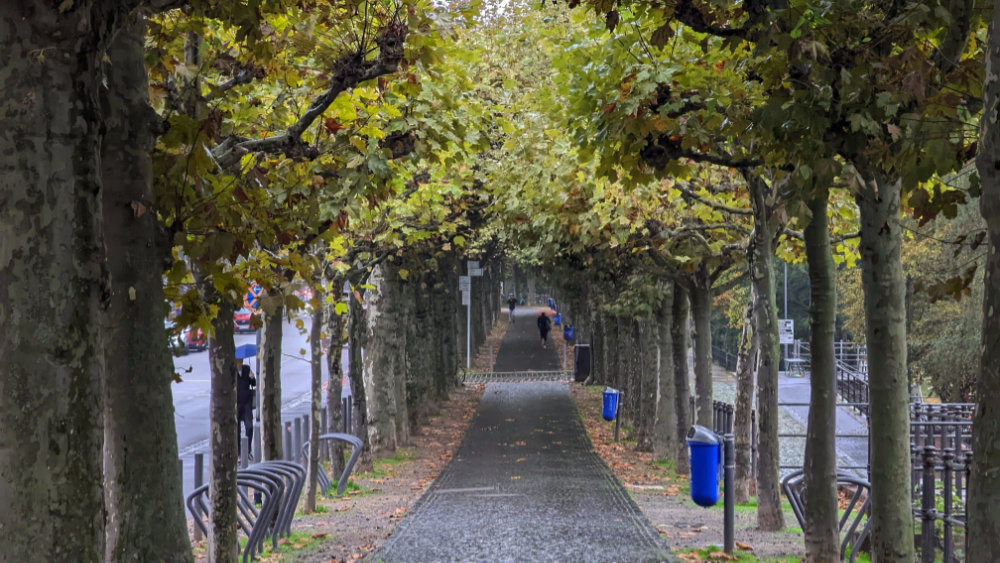
Japanese visitors are being escorted out onto the steps as I approach. They are the last to leave. They stand and gawp at the rain. The weather was evidently better when they went in. I am barred entry. The Japanese are groping for their phones and punching the Uber app. I turn, a rather disconsolate figure, step back out into the rain and gloaming and make for the footbridge and the road back to my hotel.
A WAGNER MOMENT
It is a straight walk over the river and back through the red-light district to the Holiday Inn. Holiday Inns always seem to be in particularly unholiday-like places. I remember one in a town called Suffern, in the state of New Jersey or New York (it doesn’t seem sure where it belongs). It had a scummy pool that no-one dared use in the centre of the reception area, next to the breakfast bar. The toilet in my room didn’t unlock so I guess the last inhabitant was still in there.
The Frankfurt Holiday Inn is better than that but holiday still seems a misnomer. The wallpaper of my small room is a big picture of hops growing around the wall and over my bed. It hasn’t changed since I first stayed in Frankfurt about ten years ago but it shows no sign of wear and tear or fading, as if no one else has used the room between my visits. In fact, nothing has changed in the hotel which seems trapped in a time warp – a bit like a modernist version of the Goethe Haus.
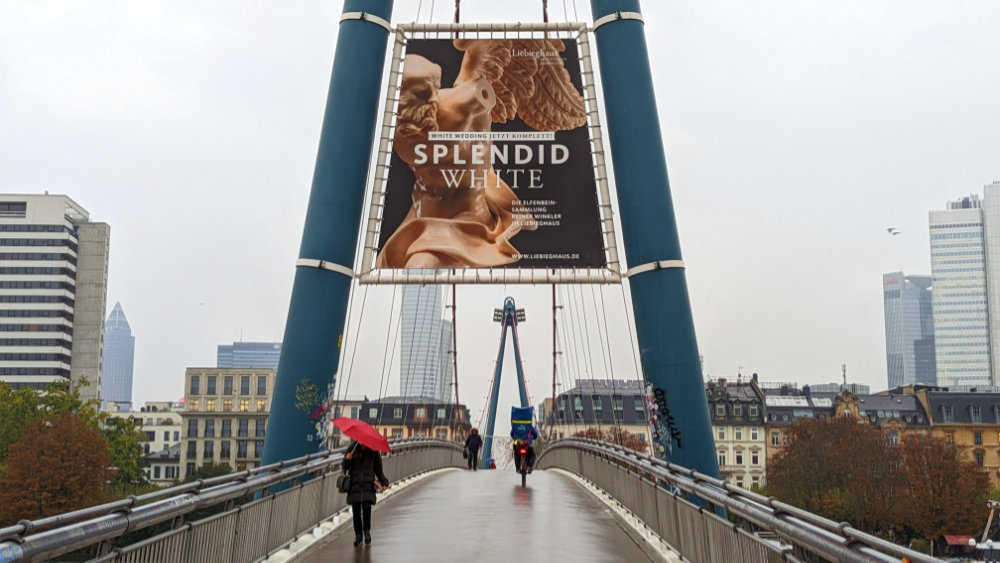
As I make the bridge to start my final leg of this long walk, I am in for a surprise. Great. Frankfurt is promoting an exhibition via big posters stretched across the bridge’s stanchions. “Splendid White” it announces over an image of a Greco-roman sculpture of an armless, winged godlike type. It is white, almost blinding in the murk of Frankfurt. It is the first white thing I have seen all day. The exhibition it is promoting is in the Liebieghaus which I may well have walked past or maybe not. Who would know. O, well, missed it at any rate, which is a shame.
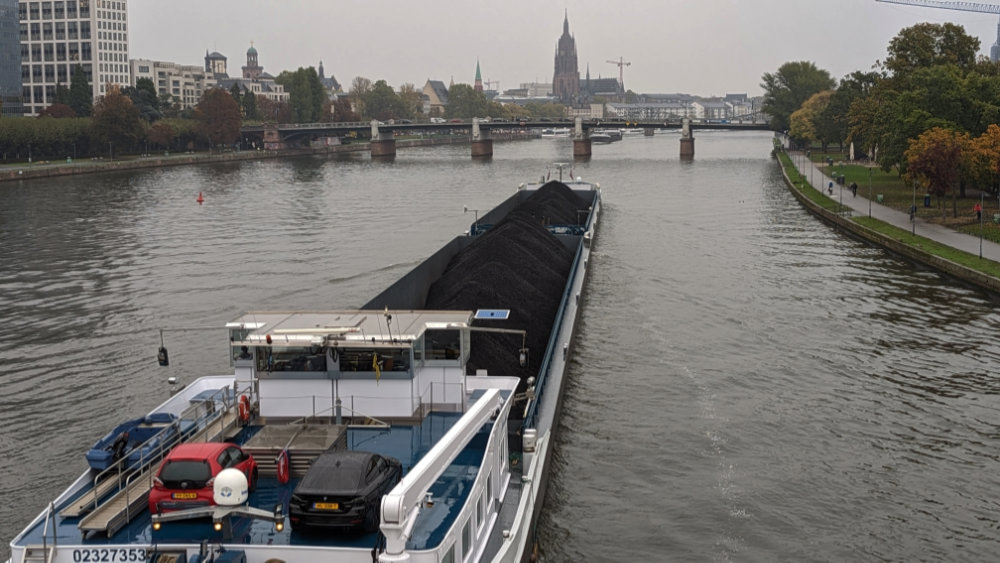
But this is not the end of the surprises that await me on the bridge over the longest tributary of the Rhine. The next one is black. O, it just gets so exciting. You see, the Germans do big and industrial very well and gliding beneath me, as smooth as a rowed scull in a pointless boat race, but as big as a skyscraper relaxing along Goethe’s divan, is a barge full of black stuff. Coal. Power. Piled in mountains in a cavernous hold, football pitch-sized and linked along the river’s length.
The barge, captained amidships by some Uber mensch with a godlike eye-patch and industrial ambition, giddies me with its monstrous slow motion. White gods above me in a Valhalla of imperious cloud-capped skyscrapers. A Nibelung’s black bergs below fuelling the furnaces a fiery downfall. I in the grey middle, a witness to the cosmic drama. This is why I like Frankfurt. The sheer, inhuman force of it all. The lack of decoration, the unfiligreed raw bluntness of power, money and sex. Wagner should have been born here and not Leipzig. Frankfurt doesn’t pull punches and it doesn’t hide its greed and lust for total domination. It is awesome.
THE HUMAN COMEDY
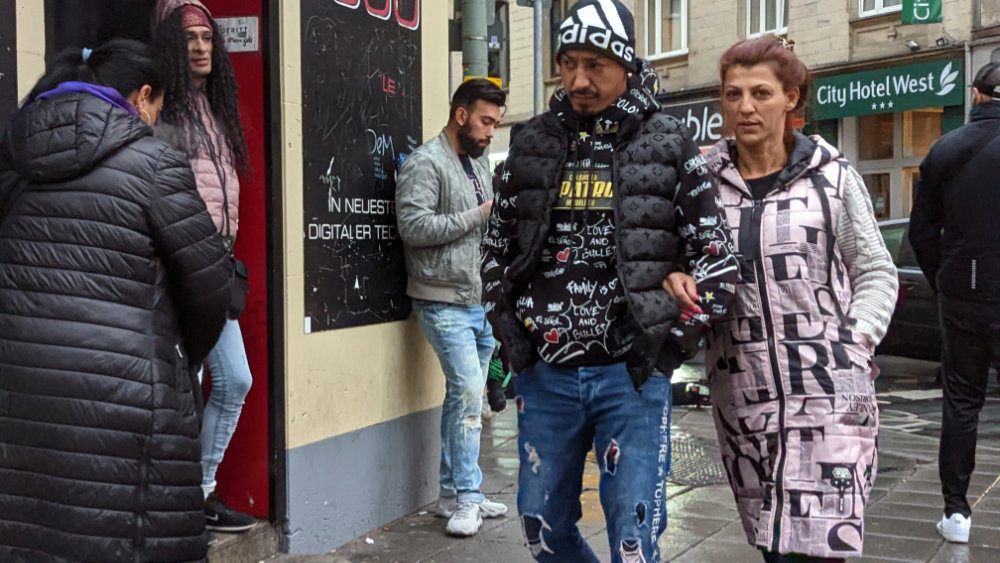
My Wagnerian reverie subsides as I meet another red traffic man on other side of the bridge. Only the red-light district to go (again). And hasn’t this sprung into life since my pallid encounter with a bare-bosomed babe hanging over a balcony earlier? This is seedy and sick on acid. Blokes can’t even be bothered finding a pissoir. One relieves himself in a doorway as I pass. A shopkeeper washes away vomit from in front of his wares. A young lad lies comatose holding a needle in his right hand with his left arm still stretched. “Girls” are standing around, behind tinted windows or smiling at me on the street. “Hello” Hello”. Furry boots, fat arses, feigned smiles.
Some of these characters look as if they died several years ago and are carried forward into limbo by a momentum of misery. I guess they are less dangerous than you might think because they can hardly run or move. The stench of bodies is everywhere. I am crossing the land of the dead and dying.
A colleague of mine once wandered onto this street by accident. He was a strait-laced chap, starched collar type. True, these are usually the geezers who leer and sniff around dodgy areas but on this occasion he came into the bar at the Holiday Inn with a face as white as a ghost. He walked up to me carrying an urgent need to speak and blurted out, “I have just seen someone injecting themselves through their eye.” I ordered him a whisky which he downed instantly and then he disappeared towards the lift and his hop-decorated room. I haven’t seen him since.
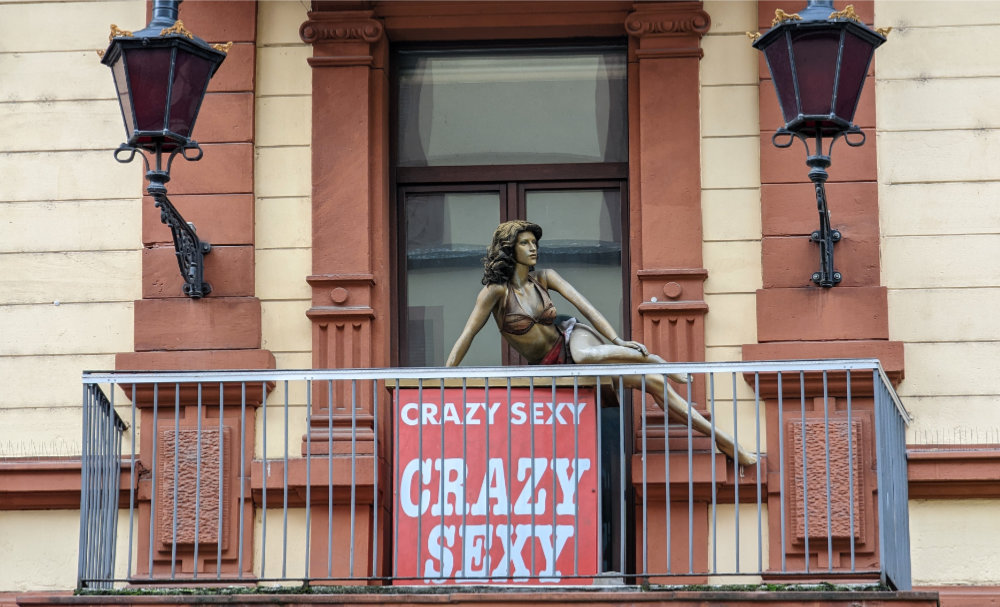
I am not one for lingering or looking back. No matter what morbid fascination the red-light district might hold, there is the danger you might see something that makes you disappear forever. Best move on and keep moving, as I said before. But you can’t help glancing. Men slip onto the street from brothels. Streets dedicated to the act that keeps the human race going are slippery with viscous waste. Women screaming, laughing, crying, Botox-lipped, Botox-bummed. All the blokes wear the same leather jacket and jeans. Everyone is dodging everyone else, on the lookout. It seems so vulpine; it seems so human. The polite society the Goethe’s cultivated seems a universe away but, in the end, I cannot tell you which I prefer. I can only witness the contrast and accept that, in the end, will all die and life goes on in all its mad manifestations with the next generations.
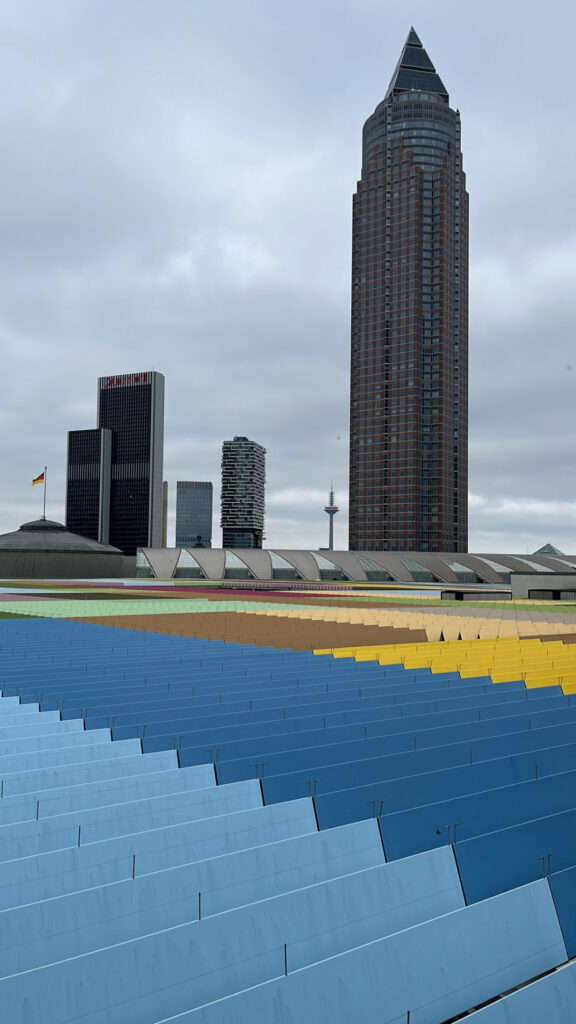
The muck and mire of bodies and desire finishes as quickly as it started. You leave it behind around about a quick stop coffee joint and you are back in the polite concrete greyness of downtown Frankfurt with its Mercedes, softly grey, purring at the traffic lights near the Holiday Inn.
Why do I like Frankfurt? I am not sure. There’s no black and white answer. The answer, I might say, lies in a grey area. It seems so real in an unreal kind of way, so true and unashamed of what it is, a bit of a bully who hides his nicer side. It is sexy and sad. I think it is the most confessionally human city I know. It doesn’t dress up and pretend it is something it isn’t, put on airs and graces. As soon as I arrive under that big iron roof of the Hauptbahnhoff, I feel at home.
I will come back next year, gaze across the skyline in front of the hops papering my hotel room. I will flick through the unexciting list of pointless TV channels, then put on my shoes and go for a walk among the grey.